
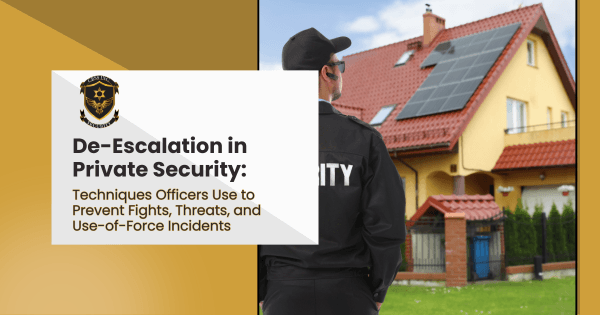
De-escalation in private security is the deliberate use of observation, calm communication, active listening, safe positioning, clear boundaries, and tactical judgment to reduce tension and create a safer resolution. The goal is to slow the encounter, give people workable choices, and resolve the issue without physical force whenever circumstances permit. The U.S. Bureau of Labor Statistics recorded 733 fatal occupational injuries involving violent acts in 2024, including 470 workplace homicides, reinforcing why businesses need prevention-focused procedures and officers who understand their broader duties and responsibilities.
De-escalation is not passive behavior. A security officer can communicate calmly while protecting an entrance, moving bystanders, requesting backup, or taking emergency action when an immediate danger exists.
What De-Escalation Means in Private Security
De-escalation is a structured safety process, not a clever phrase or a single conversational trick. An officer observes what is happening, assesses the person and the environment, communicates with purpose, creates safer options, and then resolves the issue or requests additional resources.
A practical sequence looks like this:
- Observe the person, surrounding activity, and changes in behavior.
- Assess the immediate threat, available exits, bystanders, and possible hazards.
- Communicate in a calm, respectful, and understandable way.
- Create safer options that support cooperation without abandoning the security objective.
- Resolve or request resources based on how the encounter develops.
This prevention-first approach is an important part of professional security guard services. Waiting until an argument becomes physical leaves fewer options for everyone involved.
Prevention Does Not Mean Passivity
A calm officer can still be firm. Security officer conflict management may require the officer to deny entry, enforce a site rule, separate people, protect an access point, remove spectators, notify management, or request another officer.
The difference is that the officer does not add unnecessary emotion to the encounter. Clear limits are delivered without insults, threats, sarcasm, or personal challenges.
De-Escation Is Not Guaranteed to Work
No officer can control another person’s decisions. De-escalation creates opportunities for cooperation and may reduce avoidable security use-of-force incidents, but it cannot guarantee a peaceful outcome.
Consider a visitor who becomes angry after being denied access. An emotional response such as, “You are not getting in, so stop arguing,” may intensify the dispute. A more effective response may be, “I understand you expected to enter. This location requires authorization, but I can contact the person you are meeting or direct you to the reception desk.”
The rule remains in place. The officer simply communicates it in a way that gives the visitor a reasonable path forward.
How Security Officers Recognize Escalation Before Violence Starts
Effective de-escalation begins before a fight or assault occurs. Officers evaluate the person, the environment, nearby objects, crowd movement, available exits, bystanders, and whether behavior is changing.
Common warning signs may include:
- Increasing volume, insults, or repeated threats
- Fixation on one person or grievance
- Refusal to allow anyone else to speak
- Repeated challenges to authority
- Pacing, clenched fists, or invasion of personal space
- Sudden silence following intense agitation
- Statements suggesting imminent harm
- Attempts to reach restricted areas or move around the officer
No single behavior proves that violence will occur. Officers should consider the totality of what they can observe rather than making assumptions based on appearance, disability, culture, or another personal characteristic.
Environmental and Physical Risk Factors
The same conversation may present different risks depending on the setting. A disagreement in an open lobby is not identical to one in a crowded hallway with blocked exits.
Officers may consider:
- Whether either party has a safe route away
- Whether children or vulnerable people are nearby
- Whether objects could be used as weapons
- Whether noise or spectators are increasing agitation
- Whether the officer can withdraw safely
- Whether another officer or manager is available
These considerations are especially important in customer-facing assignments such as retail security, hospitality, healthcare, and residential security.
Frustration, Noncompliance, and Immediate Threats Are Not the Same
An upset person who is speaking loudly but answering questions presents a different problem from someone advancing on another person while making a specific threat.
Good security officer conflict management depends on distinguishing among frustration, policy resistance, emotional distress, intoxication, and immediate danger. The response should be based on observable conduct and current risk, not a label assigned to the person.
8 De-Escalation Techniques Security Officers Use
The following security guard de-escalation techniques combine communication, judgment, and tactical positioning.
1. Control Tone, Pace, and Emotional Reactions
Officers should speak calmly, audibly, and firmly without shouting. Slowing the pace of speech can help slow the pace of the interaction.
Professional wording: “Let us take this one step at a time. Tell me what happened.”
Matching anger with anger often turns a manageable disagreement into a contest over authority.
2. Use Active Listening Before Giving Directions
Active listening for security guards includes allowing a person to explain, asking focused questions, paraphrasing the concern, and identifying the outcome the person wants.
Professional wording: “You are saying your name should be on the visitor list, but the front desk cannot find it. Is that correct?”
Listening does not require the officer to agree. It shows that the officer understands the issue before explaining what can happen next.
3. Use Neutral and Respectful Language
Neutral language focuses on behavior, site policy, and available options.
Escalating: “You are causing a problem and need to leave.”
Better: “This area is restricted, but I can help you find the correct entrance.”
Respectful wording is particularly valuable when officers work around customers, residents, patients, executives, or employees who expect a professional environment.
4. Explain the Rule and the Reason
People may resist instructions that appear arbitrary. A short explanation can make a boundary easier to understand.
Professional wording: “We verify every visitor after hours so unauthorized individuals do not enter the building.”
The officer should avoid turning the interaction into a lengthy policy debate. Explain the reason, state the available options, and continue monitoring behavior.
5. Offer Limited, Realistic Choices
Two safe options can restore a sense of control while preserving the security objective.
Professional wording: “We can discuss this near the lobby desk, or I can contact the property manager for you.”
Both choices must be genuine. An officer should not offer an option that violates post orders or cannot actually be provided.
6. Preserve Dignity and Provide a Face-Saving Exit
Public humiliation can make cooperation more difficult. When safe, the officer can move the conversation away from an audience, reduce unnecessary attention, and avoid language designed to embarrass the person.
Professional wording: “Let us step over here so we can speak without everyone crowding around.”
Preserving dignity does not excuse misconduct. It gives the person a way to comply without feeling that surrendering the argument means losing status in front of others.
7. Use Time, Distance, Barriers, and Positioning
Nonverbal de-escalation techniques matter as much as words. Officers can maintain appropriate distance, avoid trapping the person, keep exits accessible, and use counters or other environmental features as natural barriers.
The officer’s stance should remain alert without appearing unnecessarily aggressive. Depending on the assignment, this principle applies to lobby posts, parking facilities, warehouses, and mobile patrol security.
8. Request Backup or Transfer the Response
Knowing when to request help is part of de-escalation. Another officer, supervisor, property manager, medical professional, crisis resource, or law-enforcement agency may be better equipped to handle the next stage.
According to the CISA De-Escalation Action Guide, personnel should prioritize safety, recognize their limits, and obtain assistance when a situation may become violent.
Professional wording: “I am contacting my supervisor so we can address this safely.”
Security Officer De-Escalation Response Checklist
- What behavior am I observing?
- Is there an immediate threat?
- Where are the exits, bystanders, and potential hazards?
- Is my tone calm, clear, and respectful?
- Have I listened before giving directions?
- Can I offer two safe, realistic choices?
- Am I maintaining appropriate time and distance?
- Do I need backup, emergency services, or management?
- What facts must be documented after the incident?
How De-Escation Changes in Common Security Scenarios
Security guard conflict resolution is not based on a universal script. The officer’s priorities must change with the environment, behavior, and available resources.
An Angry Customer or Visitor
Situation: A customer is yelling after being denied a return or a visitor is disputing an access decision.
Officer priority: Move the discussion away from employees or customers, listen for the underlying complaint, explain the applicable rule, and identify who has authority to address it.
Possible response: “I understand you want this reviewed. Let us move away from the entrance, and I will contact the manager.”
Two People Moving Toward a Fight
Situation: Two people are exchanging threats and closing the distance between them.
Officer priority: Request assistance early, create separation when safely possible, redirect attention, remove spectators, and give each person a different path away.
Possible response: “Both of you need to step back. You, remain near the front desk. You, move toward the exit while another officer comes to speak with you.”
A lone officer should not assume that physically entering every fight is safe or appropriate.
An Intoxicated or Highly Agitated Guest
Situation: A guest is confused, repetitive, or reacting unpredictably.
Officer priority: Reduce stimulation, use short instructions, avoid complex arguments, repeat boundaries calmly, and request backup before conditions deteriorate.
Possible response: “Please stay here. We are arranging a safe way for you to leave.”
A Workplace Threat or Person in Crisis
Situation: An employee, former employee, or visitor makes a serious threat.
Officer priority: Assess immediacy, protect potential targets, move bystanders, discreetly request assistance, and follow the site’s workplace violence procedures.
Officers should not attempt to diagnose a person. They should describe observable behavior, communicate factual information, and follow the emergency plan. Businesses can review additional prevention guidance through OSHA’s workplace violence resources.
When De-Escalation Is No Longer the Appropriate Primary Response
Communication cannot replace emergency action when an immediate threat to life or safety exists.
Signs the Situation Requires Immediate Escalation
- A visible or reported weapon
- An assault in progress
- A specific and immediate threat
- Serious injury or medical distress
- Fire, evacuation, or another environmental emergency
- Rapidly deteriorating conditions the officer cannot safely contain
When these indicators are present, the appropriate response may include withdrawing, moving others to safety, maintaining observation from a protected location, notifying emergency services, and following site-specific procedures.
Safety Takes Priority Over Winning an Argument
The purpose of security is not to win a verbal contest. Continuing direct contact simply to demonstrate authority can expose the officer, employees, visitors, and bystanders to greater danger.
Officers assigned to elevated-risk environments, including those providing armed security protection, still benefit from disciplined communication and restraint. Armed status does not turn every disagreement into a force problem.
Legal and Operational Disclaimer: This article provides general educational information and is not legal advice, a use-of-force policy, or a substitute for site-specific training. Security personnel must follow applicable law, licensing requirements, employer policies, post orders, and emergency procedures. Businesses should obtain qualified legal and security guidance when developing workplace violence and incident-response plans.
What Effective De-Escalation Training and Supervision Look Like
Reliable de-escalation depends on more than an individual officer’s personality. It requires training, clear post orders, supervision, reporting, and review.
Scenario-Based Training
Training should allow officers to practice realistic situations involving denied access, intoxicated guests, aggressive customers, employee disputes, removal requests, and potential threats.
The goal is not to memorize a script. It is to practice decision-making while maintaining composure.
Site-Specific Post Orders and Escalation Procedures
Officers should know:
- Who has authority to make operational decisions
- When a supervisor must be contacted
- When police, fire, or medical assistance should be requested
- Where safe rooms and evacuation routes are located
- What actions fall within the officer’s assignment
Assignments such as hospital security require different communication and escalation considerations from warehouses, construction sites, residential communities, or corporate offices.
Incident Reporting and Supervisor Review
Reports should identify observable facts, including:
- Statements and behavior observed
- Instructions and choices provided
- Resources requested
- Witness information
- Injuries or property damage
- The final disposition
Emotional conclusions such as “the person was crazy” should be replaced with specific observations such as “the individual paced near the entrance, shouted repeatedly, and threatened to strike an employee.”
California employers covered by the state’s workplace violence prevention requirements should review the applicable Cal/OSHA guidance, including plan, training, incident-log, and post-incident obligations.
Refresher Training and Corrective Coaching
After an incident, supervisors should ask what officers observed, what actions helped, what increased tension, whether backup was requested at the right time, and whether post orders were adequate.
Constructive debriefing turns individual incidents into practical improvements.
How Businesses Should Evaluate a Security Provider’s De-Escalation Practices
Before hiring or renewing a security provider, decision-makers should ask:
- What communication and de-escalation training do officers receive?
- Are officers trained through realistic, site-specific scenarios?
- How are high-risk and use-of-force incidents reviewed?
- What procedures govern requests for supervisors or emergency services?
- How are threats, confrontations, and officer actions documented?
- How will officers coordinate with our workplace violence procedures?
- How are officers matched to hospitality, residential, retail, healthcare, warehouse, or high-risk assignments?
A managed security operation should involve more than filling a post. Businesses should expect defined responsibilities, supervision, escalation procedures, and reporting that fits their industry and operating environment.
Security Provider De-Escalation Evaluation Scorecard
Rate each category from 1 to 5:
- Officer communication training
- Scenario-based preparation
- Site-specific post orders
- Supervisor availability
- Emergency escalation procedures
- Incident-report quality
- Use-of-force review
- Coordination with management
- Refresher training and corrective coaching
Build a Security Plan That Makes Prevention the First Response
Effective workplace violence prevention security combines officer judgment, communication, site procedures, supervision, reporting, and emergency coordination. A business should examine where confrontations are most likely to occur, how employees currently respond, when management becomes involved, and what level of officer presence fits the environment.
CB Security Solutions develops coverage around the property’s layout, operating hours, visitor activity, known risks, and existing procedures. Businesses can review the company’s security solutions or request a site-specific assessment to discuss likely confrontation points, escalation expectations, and the appropriate guard strategy.
Frequently Asked Questions
What Is De-Escalation in Private Security?
De-escalation in private security involves verbal, nonverbal, tactical, and procedural actions intended to reduce tension and create a safer resolution. Officers may use calm communication, active listening, clear boundaries, distance, positioning, backup, and emergency procedures based on the circumstances.
What Verbal De-Escalation Techniques Do Security Guards Use?
Common verbal de-escalation techniques include controlling tone and pace, listening before directing, using neutral wording, briefly explaining rules, offering limited choices, confirming concerns, and setting respectful boundaries. The officer remains calm without surrendering the site’s safety or access-control requirements.
Can a Security Officer Guarantee That De-Escalation Will Work?
No. A trained officer can create safer opportunities, reduce unnecessary tension, and avoid contributing to escalation, but cannot control another person’s behavior. Some encounters will continue to deteriorate despite appropriate communication and positioning.
When Should Security Officers Call the Police?
Police or emergency assistance may be appropriate when there is an immediate danger, visible or reported weapon, assault, specific threat, serious injury, or situation beyond the officer’s ability to manage safely. The officer should also follow applicable post orders, company policies, and emergency procedures.
Takeaway
De-escalation is not simply speaking softly. It is a disciplined process of noticing risk early, communicating with purpose, preserving safety, creating workable choices, and knowing when to request help. Businesses receive the greatest value when trained officers are supported by clear post orders, responsive supervision, accurate reporting, and a site-specific prevention plan.