
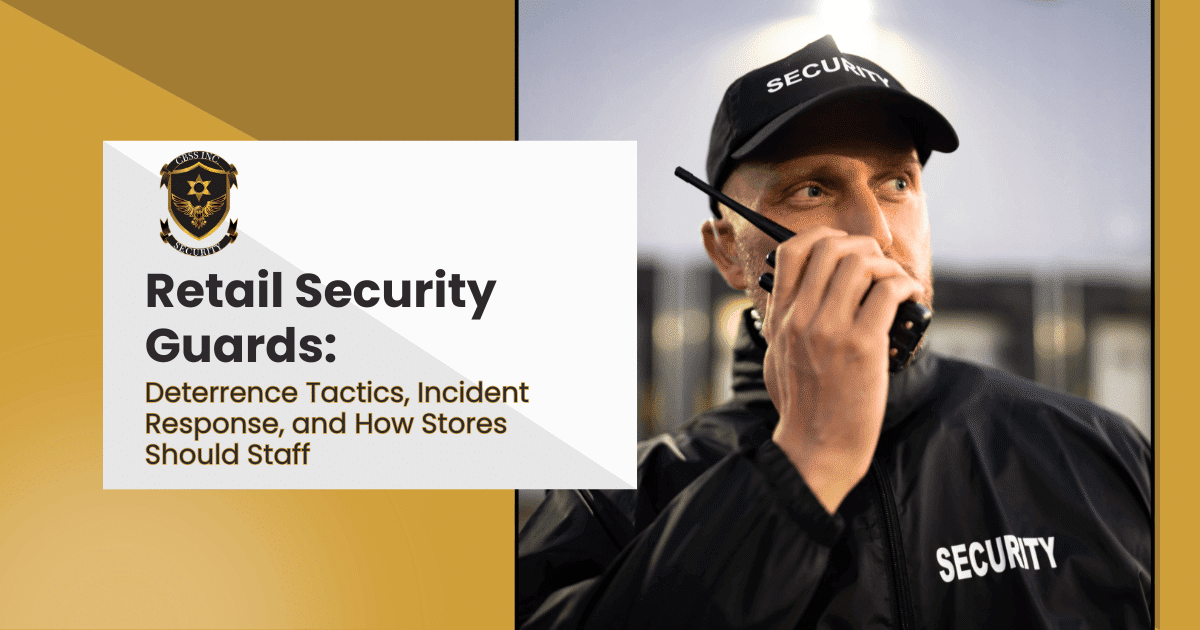
Retail security works best when it protects more than merchandise.
A strong post helps reduce shrinkage, supports employee confidence, and preserves the kind of customer experience that keeps people coming back.
For stores that want a more visible deterrent posture or need a higher-risk solution, armed security protection can be part of that strategy when the environment truly calls for it.
The need is real. According to recent industry research from the National Retail Federation, retailers have seen major increases in both shoplifting incidents and dollar losses, which is why retail security today has to be deliberate, disciplined, and operationally sharp. The goal is not to turn a store into a fortress. It is to create a place that feels orderly, watchful, and safe without feeling hostile.
Retail Security Goals: Safety, Shrink Reduction, and a Better Store Experience
The biggest mistake stores make is treating retail security like a single-purpose function. It is not just there to catch thieves. It is there to shape behavior before an incident starts, give employees confidence when something feels off, and help customers feel that the environment is under control.
Good retail security usually serves three goals at the same time:
- Safety: protecting staff, customers, vendors, and managers
- Shrink reduction: reducing theft, fraud, and avoidable loss
- Customer experience: maintaining a calm, professional sales floor
Those goals rise or fall on deterrence. In many stores, the most effective guard is not the one who makes the most dramatic stop. It is the one whose presence changes what people decide to do. That starts with high-visibility placement. A guard posted near the entrance, front action alley, or immediate exit zone changes the emotional temperature of a store. People know they are seen. Employees know someone is present. Potential offenders know they may be noticed before they act.
Simple habits matter more than many retailers realize. A professional greeting at entry can do several jobs at once. It tells legitimate shoppers help is available. It tells a would-be shoplifter they have been noticed. It establishes presence without confrontation. Done well, it feels like hospitality with backbone.
Store layout matters too. Security is always stronger when the space supports it. The most effective stores think carefully about:
- clear sightlines from the front of house
- reduced blind spots near corners and tall fixtures
- attention on fitting rooms, high-value displays, self-checkout, and exits
- tighter control at receiving doors and employee-only areas
- camera coverage that supports, rather than replaces, active guard presence
This is where physical design and guard deployment meet. A guard should not be wandering without purpose. Patrol patterns should be visible enough to deter, but varied enough to avoid becoming predictable. One pass through high-theft zones every ten minutes is often less effective than irregular movement through known problem areas, especially when the guard pauses, scans, and engages with the space rather than simply walking through it.
Retailers should also think in layers. A smart deterrence plan may include:
- a fixed presence at the entrance during peak traffic
- mobile patrols through high-loss departments
- stronger observation near fitting rooms and side exits
- dock and delivery checks during receiving windows
- closing and opening support during vulnerable times of day
The point is not to create theater. The point is to build a store rhythm where security presence feels natural, consistent, and difficult to game. In that kind of environment, guards become part of the store’s operating system, not an afterthought.
For retailers facing repeat theft, aggressive behavior, or more complex exposure, this is often the moment to move beyond casual coverage and consider a more structured armed security protection plan tailored to the site’s real risk profile.
Incident Response: What Guards Should Do, What They Should Avoid, and How to Preserve Evidence
Retail incidents rarely unfold the way managers imagine them on paper. A suspected theft can become a verbal confrontation. A customer dispute can spill into threats. A trespass issue can turn into a refusal to leave. That is why incident response has to be rooted in calm process, not adrenaline.
The strongest retail guards are trained first as observers, communicators, and stabilizers. Their first job is to read what is happening, assess immediate risk, and choose the response that protects people without escalating the moment unnecessarily.
In practice, that often means the first moves are simple:
- create distance where possible
- use calm verbal direction
- notify management
- call law enforcement when needed
- protect staff and customers from getting pulled into the conflict
- preserve the scene and document what happened
De-escalation matters here. Tone, body language, positioning, and pacing can change the outcome of a situation in seconds. A guard who crowds a subject, argues, or performs for bystanders can make a manageable event worse. A guard who stays composed, gives clear verbal cues, and avoids ego-driven engagement is much more likely to keep the situation from tipping into violence.
Just as important are the legal boundaries. In California, retail security teams must understand the difference between store policy, detention authority, and police powers. Guards are not law enforcement. They are there to protect people and property, observe carefully, intervene within legal and company limits, and escalate appropriately. Stores that blur that line invite risk.
That is especially important in suspected theft cases. California law gives merchants and their agents limited detention authority in specific circumstances, but those boundaries matter. The detention must be grounded, reasonable, and handled in a lawful manner. It is not a free pass for rough treatment, improvisation, or broad searches. That is why retailers need written protocols, scenario training, and supervision rather than vague instructions like “use your judgment.”
A practical response framework often looks like this:
- Suspicion phase: observe behavior, confirm facts, and communicate internally
- Intervention phase: approach only when policy and circumstances support it
- Control phase: protect people, prevent flight where lawful, and summon police if needed
- Stabilization phase: separate witnesses, secure merchandise, preserve video, and reset the floor
After the moment passes, the work is not over. Evidence preservation is where many stores lose the value of an otherwise solid response. A good security program should preserve:
- time-stamped incident reports
- video pulls from relevant cameras
- witness names and short statements
- recovery logs for merchandise
- officer and manager narratives
- notes about force, threats, injuries, or police contact
Speed matters. Video that is not flagged can be overwritten. Witnesses who are not identified quickly disappear. Small details about routes, concealment, tags, companions, vehicles, and statements fade fast. Good documentation makes follow-up possible. Bad documentation turns a real event into an unusable story.
Retailers should also remember that incident response is not only about theft. It includes medical calls, disorderly conduct, aggressive returns, employee safety concerns, parking lot issues, and opening or closing vulnerabilities. The right guard is not simply someone willing to confront. It is someone trained to recognize which situations call for presence, which call for de-escalation, and which call for immediate law enforcement coordination.
If your store has reached the point where incident handling is inconsistent, reports are thin, or staff feel unsupported during high-stress events, it may be time to contact CB Security Solutions for a more disciplined retail security plan.
How Stores Should Staff: Matching Coverage to Risk, Layout, and Peak Hours
There is no single perfect retail staffing model. A luxury boutique, a grocery store, a pharmacy, and a big-box location will not need the same posture. What matters is whether staffing matches real conditions on the ground.
Many stores start too light. They assign one guard, expect that person to deter theft, respond to incidents, support staff, monitor exits, and write strong reports, all while covering a large floor plate. Sometimes that works. Often it leaves obvious gaps.
The better approach is to build staffing around risk, hours, and layout.
Common models include:
- Single-post coverage: best for smaller stores with limited traffic and a clear front entrance
- Two-officer model: stronger for busier stores, higher-risk environments, and locations with frequent incidents
- Roving plus fixed coverage: useful when one guard anchors the entrance while another patrols high-theft zones
- Peak-hour staffing: adds coverage during evenings, weekends, delivery windows, holidays, or known incident spikes
A single-post model can be effective when the guard has a clear line of sight, management support, and a store layout that is easy to read. It becomes much less effective when fitting rooms, secondary exits, or stockroom corridors create too many blind spots.
The two-officer model is often where retail security becomes meaningfully stronger. One guard can maintain the visible deterrent role while the other handles patrols, support calls, and incident response. That split matters. It prevents the whole security posture from disappearing the moment one issue pulls the officer off the front.
Peak-hour staffing is another smart move that too many stores overlook. A store may not need the same coverage at 10:00 a.m. on Tuesday that it needs on Friday night, during holiday traffic, or near closing. Staffing should reflect patterns, not habit. That means looking closely at data.
Strong retail KPIs usually include:
- incident count by day and hour
- merchandise recovery totals
- calls for service
- trespass and repeat-offender patterns
- response times to manager requests
- hot spots by department or exit
- opening and closing issues
- report completion quality and timing
These numbers should not be used just to justify security spend. They should guide deployment. If incidents cluster around fitting rooms between 4:00 p.m. and 8:00 p.m., staffing should move there. If receiving dock shrink spikes during vendor windows, coverage should shift there. If repeat disorder centers around front-end disputes, the post order should reflect that reality.
This is also where chain of command matters. A retail post should never feel improvised. Guards need to know who they report to, when management should be notified, when police should be called, how evidence is preserved, and what the written response ladder looks like. That kind of clarity keeps the store steady when pressure rises.
At CB Security Solutions, retail coverage is built around professional presence, clear post expectations, daily logs, incident reports, and active supervisor oversight. That structure matters because stores do not just need bodies on site. They need consistency. They need guards who know how to deter, respond, document, and communicate in a way that protects both the people in the building and the business itself.
For stores that need a stronger front-facing deterrent, a more controlled response posture, or support for higher-risk conditions, armed security protection may be appropriate. And for retailers ready to build a tighter staffing plan around real site conditions, the next step is simple: contact CB Security Solutions.
Takeaway
Retail security is most effective when it is visible, lawful, calm, and well-matched to the store it protects. The right guard program does more than react to theft. It reduces opportunity, supports employees, protects customers, and gives management a clearer grip on what is happening across the floor.
When deterrence, incident response, staffing, and reporting all work together, security stops feeling like a patch and starts functioning like part of the store’s operational backbone.