
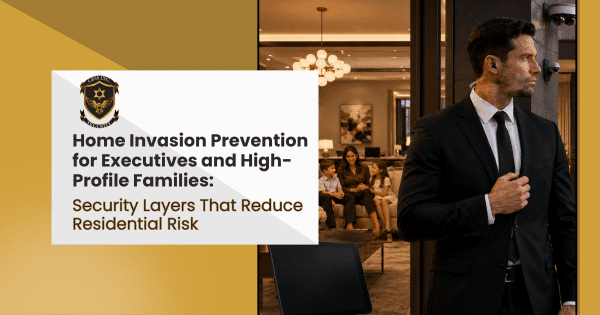
A residential alarm can warn a family that something is wrong, provide information, verify a visitor, reinforce a vulnerable entrance, or coordinate a household’s response. Effective home invasion prevention depends on overlapping layers that assess risk, discourage unwanted activity, detect suspicious behavior, delay unauthorized entry, and support a calm response.
Preliminary FBI data indicate that property crime declined nationally from 2024 to 2025, but national averages cannot measure the targeted risk facing a particular executive, public figure, or high-profile household. Families with elevated visibility should treat residential protection as part of a broader physical security strategy for executives, tailored through a confidential, site-specific assessment by qualified professionals.
Why Executives and High-Profile Families Face Different Residential Risks
High-profile residential risk is the possibility that a household may be identified, observed, approached, or targeted because of a resident’s wealth, authority, public visibility, professional decisions, family relationships, or predictable routines.
Conventional home-security advice is usually designed to discourage opportunistic property crime. Residential security for high-profile families must also consider threats connected to the identities of the people living inside the home.
The ASIS International Executive Protection Standard describes executive protection as a structured, risk-based program involving assessment, intelligence, physical protection, digital security, emergency response, documentation, and continuous evaluation. That broader framework is important because residential exposure rarely exists in isolation. It may be connected to an executive’s workplace, travel schedule, public appearances, corporate disputes, or online presence.
Burglary, Home Invasion, and Targeted Threats Are Not the Same
Burglary generally involves unlawful entry into a structure to commit theft or another crime. A home invasion involves entry into an occupied residence and may create an immediate threat to the people inside. A targeted residential threat is directed at a particular person, family, property, or routine.
These distinctions affect the security strategy.
An opportunistic intruder may be discouraged by lighting, visible cameras, reinforced entrances, or signs of occupancy. A targeted individual may spend time gathering information, testing household procedures, impersonating a vendor, approaching a family member, or observing when security coverage changes.
The goal is not to assume that every household faces a sophisticated threat. The goal is to identify which scenarios are credible and prepare accordingly.
Visibility, Wealth, and Predictable Routines Increase Exposure
Residential risk may increase when information about the household becomes easy to collect. Common sources of exposure include:
- Public leadership roles or extensive media coverage
- Online photographs revealing addresses, vehicles, gates, schools, or nearby landmarks
- Real-time posts about travel or family activities
- Corporate layoffs, litigation, activism, or reputational controversy
- Frequent contractors, domestic employees, caregivers, deliveries, and visitors
- Predictable departure, arrival, school, exercise, or social routines
- Family members whose movements are easier to observe than the executive’s
A discreet program should protect the household without turning the residence into an uncomfortable fortress. The strongest strategy is usually calm, integrated, and proportionate to the actual risk.
Begin With a Residential Security Risk Assessment
Purchasing equipment before understanding the household’s vulnerabilities can create a collection of disconnected products rather than a functioning security program. A residential security risk assessment establishes what needs protection, which threats are credible, where the property is exposed, and which improvements should receive priority.
A practical assessment should follow six steps:
- Identify credible threats. Consider unwanted contact, stalking, burglary, targeted harassment, impersonation, protest activity, employee-related concerns, and threats connected to the executive’s role.
- Review personal and professional exposure. Examine public visibility, online information, known disputes, prior incidents, travel patterns, and household routines.
- Evaluate the property. Review approaches, boundaries, entrances, garages, service areas, landscaping, lighting, detection systems, communications, and emergency access.
- Study normal occupancy. Determine who is home, when the residence is vacant, how children and staff move, and how visitors are admitted.
- Estimate potential consequences. Consider threats to people, privacy, continuity, reputation, valuable property, and the family’s ability to respond.
- Prioritize practical improvements. Address urgent gaps first, then integrate longer-term physical, technological, and procedural measures.
Match Protection to the Household’s Actual Risk Profile
Not every executive needs guards, a gate, extensive surveillance, or the same level of protection at every residence. Baseline safeguards may be appropriate for all households, while enhanced measures should be justified by specific threats, vulnerabilities, or consequences.
The assessment should account for:
- Children and their transportation or school routines
- Older relatives or residents with mobility limitations
- Household employees, caregivers, and drivers
- Pets and animal-care procedures
- Multiple residences or seasonal properties
- Renovations and construction activity
- Frequent events, guests, or service appointments
- Accessibility, medical, fire-safety, and emergency-egress needs
CB Security Solutions offers a range of security and risk-management services that can be considered as part of a broader protection plan. The appropriate combination should follow the assessment, not precede it.
Layer 1: Reduce Exposure Through Privacy and Protective Intelligence
Preventing unwanted attention can reduce residential risk before anyone reaches the property. Executive privacy and security should therefore begin with the information available about the household.
Limit Publicly Available Household Information
A digital exposure review should examine:
- People-search and data-broker listings
- Public social-media profiles
- Photographs containing addresses or recognizable landmarks
- Posts revealing vehicles, schools, staff, or recurring activities
- Real-time travel and location updates
- Public contact information connected to private household channels
Family members should avoid posting live location information or announcing that the home is vacant. Photographs should be reviewed for street numbers, vehicle plates, access controls, school uniforms, shipping labels, and other details that could help someone identify the household.
Professional and household communications should also remain separate. Public business contact information should not automatically lead to private family phone numbers, personal email accounts, residential deliveries, or home addresses.
Coordinate Privacy Practices Across the Entire Household
Executive privacy cannot depend on one person. Children, assistants, drivers, caregivers, domestic staff, and trusted vendors may each hold pieces of information that become sensitive when combined.
Households should establish a discreet process for reporting:
- Suspicious messages or repeated unwanted contact
- Impersonation of a relative, assistant, vendor, or executive
- Requests for schedules, addresses, travel plans, or family details
- Unusual photography or observation near the property
- Lost credentials, keys, devices, or documents
- Possible information leaks
Guidance should remain age-appropriate and non-alarmist. The purpose is to create awareness and a reliable reporting path, not anxiety.
Layer 2: Deter, Detect, and Verify Activity Around the Property
A layered residential security system should perform three connected functions.
1. Deter
Deterrence makes unauthorized activity more difficult or less appealing. Measures may include purposeful exterior lighting, maintained landscaping, unobstructed sightlines, clearly defined property areas, controlled entrances, and an appropriate visible security presence.
Security measures should be noticeable enough to influence behavior without advertising the full plan. Detailed camera locations, blind spots, response arrangements, access procedures, and property layouts should remain confidential.
2. Detect
Detection creates early awareness of activity near assessed access points. Cameras and sensors may cover approaches, entrances, garages, gates, service areas, and other locations identified during the assessment.
The objective is not to generate the largest possible number of alerts. It is to generate useful information.
Systems should be tested during darkness, poor weather, power interruptions, and internet outages. The household should know who receives alerts, who reviews footage, when an alert is escalated, and what qualifies as a confirmed emergency.
3. Verify
Verification helps distinguish an expected delivery from an unexpected approach, a family member from an unknown visitor, and an equipment error from a credible event.
Residential visitor management should include:
- Advance notice for contractors and vendors
- A procedure for unexpected visitors
- Designated delivery and service locations
- Independent verification before granting access
- Instructions for family members and staff not to rely solely on a visitor knowing someone’s name
For properties with multiple access points, large grounds, or recurring periods of vacancy, professionally planned vehicle patrol security may provide an additional observation and deterrence layer.
Layer 3: Strengthen Access Control and Delay Unauthorized Entry
Access control should make unauthorized entry more difficult while allowing residents to leave safely during a fire, medical emergency, or other urgent event.
Reinforce Primary and Secondary Entry Points
A qualified professional should evaluate:
- Exterior doors and supporting frames
- Locks and strike areas
- Accessible windows
- Garage doors and interior garage access
- Gates and pedestrian entrances
- Guesthouses and secondary structures
- Service, utility, and delivery areas
A premium lock offers limited value when the surrounding door, frame, glass, or wall remains vulnerable. Improvements should address the complete opening while accounting for building codes, emergency egress, fire protection, accessibility, and household needs.
Public-facing security guidance should not disclose detailed floor plans, system configurations, safe locations, or equipment placement.
Manage Keys, Codes, Cards, and Mobile Credentials
Shared access codes make accountability difficult. Whenever practical, residents, staff members, and recurring service providers should receive individual credentials with permissions appropriate to their roles.
Credential-management practices should include:
- Recording issued physical keys
- Assigning individual access codes
- Removing access when employment or service ends
- Using temporary credentials for approved contractors
- Limiting access by location or time when appropriate
- Reviewing unusual access events
- Changing compromised credentials promptly
The process should support security without creating unnecessary or intrusive surveillance of household members.
Protect Connected Security Devices
Smart locks, cameras, intercoms, alarms, gates, and environmental controls may create additional entry points when they are poorly configured.
CISA’s Secure Our World guidance recommends strong, unique credentials, multifactor authentication, and timely software updates. Residential systems should also be separated from guest networks where practical, unnecessary remote access should be disabled, and digital permissions should be reviewed regularly.
The household needs a backup plan for loss of electricity, internet connectivity, cellular service, or cloud-based applications. A connected system is useful only when residents understand what happens when the connection fails.
Layer 4: Build a Response Plan the Family Can Actually Follow
Equipment detects conditions. People decide what happens next. A family home invasion response plan should be simple enough to follow during stress and flexible enough to account for different emergencies.
A practical response sequence should cover:
- Communication: Determine how residents report suspicious activity and receive reliable instructions.
- Verification: Confirm what is happening without encouraging confrontation.
- Refuge or evacuation: Establish where household members should go based on the event.
- Emergency contact: Define when and how emergency services or security personnel are contacted.
- Accountability: Confirm the location and status of residents, guests, staff, and pets.
- Post-incident action: Preserve information, document the event, repair vulnerabilities, and update the plan.
Define Who Receives and Escalates Security Alerts
The household should identify primary and backup decision-makers. Alarm companies, security providers, assistants, property managers, and family members should not issue competing instructions through separate applications and message threads.
Written procedures should identify:
- Who receives each type of alert
- Who reviews available information
- When emergency services are contacted
- Which security or property personnel are notified
- How family members receive instructions
- Where updated contact information is maintained
Establish a Designated Refuge and Communication Procedure
A qualified professional can determine whether a designated refuge area is appropriate for the residence. Planning should consider reliable communications, emergency contact information, medical needs, mobility limitations, children, visitors, and pets.
Refuge planning must also be coordinated with fire evacuation and medical response. A measure intended to delay unauthorized entry should never prevent safe escape during a different emergency.
Train Children, Caregivers, and Household Staff
Training should give each person a small number of clear actions. Households may establish a verification phrase for unusual pickups, urgent instructions, or unexpected changes in routine.
Children and staff should know how to:
- Respond to an unexpected visitor without opening the door
- Report suspicious behavior
- Reach a trusted adult or emergency contact
- Follow shelter or evacuation instructions
- Avoid confronting an unknown person
- Confirm an unusual request through a known communication channel
Practice should remain calm, private, age-appropriate, and proportionate to the household’s risk.
When a risk assessment supports dedicated personnel, professionally managed armed security protection may become one component of the plan. Armed coverage should never replace privacy controls, access management, detection, household training, or emergency coordination.
Put the Layers Together With a 30-, 60-, and 90-Day Plan
An executive residential security plan should correct urgent gaps first, then integrate the program over time.
| Timeline | Priorities |
| First 30 Days | Commission a qualified assessment, remove obvious public information, review household contacts and credentials, test alarms and cameras, and establish basic visitor and emergency procedures. |
| Days 31–60 | Complete prioritized physical improvements, configure alerts and escalation paths, train family members and staff, and coordinate with corporate security, family-office leadership, or an executive-protection provider. |
| Days 61–90 | Conduct controlled tests, correct false-alert and communication problems, review vendor access, document responsibilities, establish maintenance schedules, and reassess remaining vulnerabilities. |
The program should be reviewed following a move, renovation, staffing change, direct threat, public controversy, extended trip, system failure, or major change in family routine. Security measures should also be tested periodically rather than assumed to work because they were installed.
Request a Confidential Residential Security Assessment
No single guard, gate, camera, lock, or alarm can eliminate residential risk. Effective protection comes from selecting complementary layers and ensuring that the people, technology, physical environment, and response procedures work together.
CB Security Solutions provides professional security planning and coverage for clients with varied residential, executive, and organizational needs. Learn more about CB Security Solutions and the company’s available security services.
Request a confidential residential security assessment to identify the improvements that can produce the greatest practical reduction in risk for your property and household.
Home invasion prevention for executives begins well beyond the front door. When privacy, detection, access control, physical delay, household training, and professional response are built around a credible assessment, residential security becomes stronger, quieter, and easier to follow.