
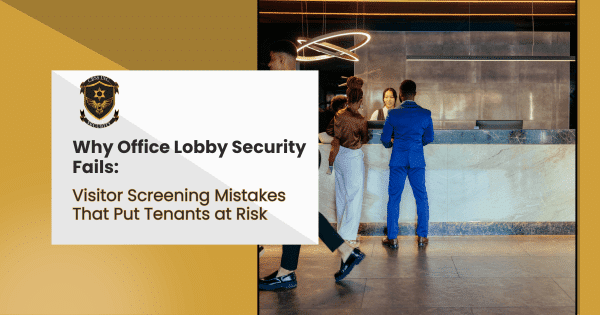
Office lobby security often fails quietly. A visitor is waved through because the desk is busy, a delivery driver follows an employee through a controlled door, or a contractor is allowed upstairs because someone assumes another person already verified them. Strong commercial security services are designed to remove those small gaps before they become larger incidents.
The risk is not theoretical. The U.S. Bureau of Labor Statistics recorded 733 fatal workplace injuries involving violent acts in 2024, including 470 homicides, reinforcing why businesses cannot treat access control as a purely administrative function. The Bureau of Labor Statistics workplace fatality data provides additional context on violence affecting workplaces nationwide.
Why Office Lobby Security Is the First Line of Defense
The lobby is where public access meets private space.
Employees know where they belong. Tenants understand the elevators, badge readers, stairwells, and restricted floors. Visitors do not, which is precisely why the lobby should create a controlled transition between arriving at the property and receiving permission to move deeper into it.
Effective building lobby security should answer four questions before someone proceeds:
- Who is this person?
- Why are they here?
- Who authorized the visit?
- Where are they permitted to go?
When those questions are answered consistently, the lobby becomes more than a reception area. It becomes a working security checkpoint.
What Effective Lobby Security Should Accomplish
Good lobby access control should make legitimate visitors feel welcomed while making unauthorized access difficult.
Security personnel may verify identification, confirm appointments, issue temporary credentials, communicate with tenants, monitor entrances, observe suspicious behavior, document unusual activity, and manage access beyond reception.
These responsibilities are consistent with the broader duties and responsibilities of security officers, where observation, access control, communication, documentation, and professional judgment all work together.
Why High-Traffic Office Buildings Create Screening Challenges
The busier the building, the easier it becomes for shortcuts to feel normal.
Morning arrivals can bring employees, clients, food deliveries, maintenance technicians, interview candidates, attorneys, vendors, couriers, and contractors through the same entrance within minutes.
The danger is familiarity.
Once lobby staff become accustomed to seeing hundreds of legitimate people, someone who looks confident, carries a laptop bag, or walks behind an employee may receive less scrutiny than the building’s visitor management security procedures require.
Consistency matters most when traffic is highest.
Mistake #1: Allowing Visitors to Enter Without Proper Identification
One of the simplest visitor screening failures is allowing appearance, confidence, or familiarity to replace verification.
A person who says, “I’m meeting someone on the seventh floor,” has provided a reason for being there. They have not established that they are authorized to enter.
Why Visual Recognition Is Not a Reliable Security Procedure
Recognition can support visitor verification, but it should not replace established procedures.
Guards change shifts. Tenants move. Contractors change personnel. Former employees may still look completely familiar. Someone who visited the property several months ago may no longer have authorization today.
Professional screening follows the procedure rather than the feeling.
What Information Security Staff Should Verify Before Granting Access
Depending on the property’s policies, visitor ID verification may include:
- Name and identification
- Company or organization
- Tenant or employee being visited
- Purpose of the visit
- Appointment or authorization status
- Permitted destination
The goal is not to interrogate visitors. It is to establish identity and authorization before access is granted.
Mistake #2: Failing to Confirm Visitors With the Tenant or Employee
Knowing who someone claims to be visiting does not prove that the tenant is expecting them.
A visitor may know an employee’s name from previous business dealings, a company website, social media, or information available in the lobby directory.
How Unverified Guests Gain Access to Restricted Areas
Unauthorized building access often depends on ordinary human behavior. People tend to assume that someone who knows the right name, appears professional, or speaks confidently probably belongs.
That assumption creates a security gap.
Visitor authorization should come from the person or organization receiving the visitor, not solely from the visitor.
A Better Visitor Confirmation Process
A secure visitor check-in process can be simple:
- Identify the visitor.
- Determine whom they are visiting.
- Contact the tenant using an approved communication method.
- Receive confirmation.
- Issue the appropriate credential.
- Provide access only to approved areas.
If the tenant cannot be reached, lobby personnel should follow established escalation procedures instead of improvising.
Mistake #3: Using Sign-In Sheets as the Entire Visitor Screening System
A clipboard can record information. It cannot determine whether that information is true.
Traditional visitor sign-in security becomes weak when the log itself is treated as authorization.
What Traditional Visitor Logs Fail to Capture
A handwritten building visitor log may not confirm:
- Whether identification was checked
- Whether the tenant approved the visitor
- Which areas the visitor entered
- Whether a temporary badge was issued
- When the visitor actually left
- Whether the stated company or purpose was legitimate
A log can be useful evidence of activity, but it is only one part of visitor tracking.
When Digital Visitor Management Improves Accountability
Digital visitor management systems can support pre-registration, host notifications, time records, credentialing, searchable histories, and consistent visitor procedures.
Technology still needs human oversight. A sophisticated system becomes ineffective if staff routinely override it or allow visitors around it.
The principle is simple: technology should reinforce the procedure, not replace the people responsible for enforcing it.
Mistake #4: Letting Visitors Bypass the Lobby Through Tailgating
A controlled front desk means little if someone can simply follow an authorized person through the next door.
Tailgating security should therefore be considered part of the visitor screening process, not a separate problem.
How Tailgating Happens in Busy Office Buildings
It often looks completely harmless.
An employee badges through a door and holds it open. Someone carrying packages follows closely behind. A group exits an elevator while another person enters. A visitor walks through a turnstile behind a tenant.
Courtesy creates the opening.
The Cybersecurity and Infrastructure Security Agency provides physical security resources for commercial facilities emphasizing protective measures, credentialing, security planning, communication, and training.
How Security Guards Can Prevent Piggybacking Without Disrupting Tenants
Piggybacking prevention does not require treating every person as suspicious.
Guards can politely stop unknown individuals, request credentials, redirect visitors to check-in, monitor controlled doors during peak periods, and remind employees not to defeat access-control measures for convenience.
Good security feels firm without feeling hostile.
Mistake #5: Failing to Control Deliveries, Vendors, and Contractors
Not every visitor should be screened in exactly the same way.
A client attending a meeting and an HVAC technician requesting mechanical-room access present different operational considerations.
Why Vendors Require Different Screening Procedures Than Regular Guests
Vendor access management should account for where contractors need to go, what work they are performing, how long they should remain on-site, and whether their activities involve restricted infrastructure.
Property managers should establish procedures for recurring vendors and unexpected service calls before they arrive.
Verifying Work Orders, Service Calls, and Delivery Destinations
A vendor verification procedure may include:
- Confirming the company
- Checking identification
- Verifying the work order
- Confirming the property contact
- Identifying the approved work area
- Recording arrival and departure
- Requiring an escort when appropriate
A uniform, toolbox, delivery bag, or branded vehicle should never function as a substitute for authorization.
Mistake #6: Giving Visitors Too Much Access After Check-In
Passing lobby screening should mean a visitor is authorized for a specific purpose.
It should not automatically mean unrestricted access throughout the property.
Why Lobby Approval Should Not Mean Building-Wide Access
Office buildings may contain executive suites, employee-only areas, server rooms, storage spaces, parking structures, tenant floors, mechanical areas, and sensitive records.
Visitor access control works best when permissions match the visit.
Visitor Badges, Escorts, and Floor-Specific Access
Depending on the building, controls can include:
- Clearly visible visitor badges
- Temporary access credentials
- Floor-specific elevator permissions
- Tenant escorts
- Restricted stairwell access
- Time-limited credentials
For elevated-risk environments, a property may require more specialized coverage. CB Security Solutions also provides armed security protection when a site’s threat profile supports a stronger security posture.
Mistake #7: Security Guards Without Clear Lobby Post Orders
Even capable guards make inconsistent decisions when nobody has clearly defined what they are supposed to do.
Security guard post orders turn general expectations into repeatable procedures.
What Lobby Security Post Orders Should Cover
Lobby post orders should address situations such as:
- Visitor identification requirements
- Tenant confirmation procedures
- Deliveries and food couriers
- Contractors and service technicians
- After-hours visitors
- Lost or forgotten employee credentials
- Tailgating
- Suspicious behavior
- Persons refusing to comply
- Emergency escalation
- Incident documentation
The more predictable the procedure, the less frequently guards need to invent solutions in real time.
Why Inconsistent Guard Decisions Create Security Gaps
If one officer requires identification while another does not, visitors quickly encounter two different security systems at the same building.
Consistency protects the property and the officer.
A professional security operation should define expectations, train personnel, supervise performance, and update instructions when the site’s needs change.
Mistake #8: Ignoring Suspicious Behavior Because Someone Looks Like They Belong
Professional appearance proves very little.
Someone in business attire can still be unauthorized. Someone dressed casually can be a senior tenant executive.
Security awareness should focus on behavior and circumstances rather than stereotypes.
Common Behavioral Red Flags in Office Lobbies
Depending on context, suspicious visitor behavior may include someone who:
- Repeatedly watches access-controlled doors
- Avoids the security desk
- Attempts to follow employees through restricted entrances
- Gives changing explanations about their destination
- Becomes unusually resistant to routine verification
- Tests multiple entrances
- Photographs sensitive security features without an apparent reason
None of these automatically proves malicious intent. They may, however, justify additional verification.
How Guards Can Investigate Without Creating an Unwelcoming Environment
Professional security screening is often conversational.
A calm “Who are you here to see?” or “Let me verify that appointment for you” can resolve uncertainty without confrontation.
The best customer-facing security guards understand that professionalism and vigilance are compatible.
OSHA’s workplace violence guidance specifically encourages employers to assess worksite risks and incorporate controls, procedures, and training into prevention planning.
Mistake #9: Poor Coordination Between Security, Property Management, and Tenants
Security cannot enforce information it does not have.
Property management, tenants, reception personnel, and security teams need a reliable method for communicating changes that affect access.
Why Outdated Tenant Lists and Access Instructions Cause Problems
Consider what happens when:
- An employee leaves the company.
- A tenant changes floors.
- A contractor’s project ends.
- A restraining instruction is issued.
- A vendor relationship terminates.
- Building hours change.
- A new executive begins working on-site.
If security receives none of that information, the lobby may continue operating under yesterday’s assumptions.
Creating a Clear Escalation Process for Unusual Visitors
Security escalation procedures should specify who makes decisions when the normal process fails.
The guard should know:
- Who represents property management
- Who can authorize exceptions
- How tenants should be contacted
- When supervisors become involved
- When law enforcement or emergency services should be called
- How unusual encounters should be documented
CB Security Solutions builds coverage around site-specific operations rather than treating every property the same. Businesses can review the company’s broader security services and the industries CBSS serves when evaluating the appropriate structure for their property.
What an Effective Office Lobby Visitor Screening Process Looks Like
Strong office visitor screening does not need to feel complicated. It needs to be consistent.
Step 1: Establish the Visitor’s Identity
Determine who has arrived and verify identification when required by building policy.
Step 2: Confirm the Purpose of the Visit
Ask why the person is there and whom they intend to see.
Step 3: Verify Authorization With the Tenant
Use an approved contact method to confirm that the visitor is expected.
Step 4: Issue the Appropriate Badge or Access Credential
Temporary credentials should clearly identify the visitor and provide only the access required.
Step 5: Control Access Beyond the Lobby
Use escorts, turnstiles, elevator controls, guards, or other access-control measures appropriate to the property.
Step 6: Record Departure and Recover Temporary Credentials
Close the loop. Record departure when required and recover temporary badges or credentials so they cannot be reused.
How to Evaluate Whether Your Office Lobby Has Security Gaps
A property does not need to experience a major incident before reviewing its procedures.
In fact, the best time to identify a weak point is when nothing is happening.
Review Visitor Entry and Check-In Procedures
Watch the lobby during normal operations.
Are IDs actually checked? Are tenants consistently contacted? Can guards explain what happens when someone is not on the visitor list? Are temporary credentials recovered?
Written policy and actual practice should match.
Identify Side Entrances, Blind Spots, and Access-Control Weaknesses
The lobby is only one part of the building.
Review parking entrances, loading areas, stairwells, employee doors, garages, elevators, exterior gates, and after-hours entry points. Larger properties may also benefit from combining stationary coverage with vehicle patrol security for exterior areas and broader perimeter oversight.
Test How Staff Respond to Unannounced or Unverified Visitors
A useful security assessment examines what actually happens when a routine situation becomes unusual.
What if someone claims the tenant forgot to put them on the list? What if a delivery driver demands upstairs access? What if an employee forgot a badge? What if someone refuses to provide identification?
Those moments reveal whether the building has a real procedure or merely a front desk.
Strengthen Office Lobby Security Before a Screening Failure Becomes an Incident
Office lobby security works when people, procedures, access-control technology, communication, and supervision reinforce one another.
A professional security assessment can identify weaknesses in visitor screening, side entrances, staffing levels, post orders, access credentials, vendor management, tenant communication, incident response, and escalation procedures. From there, property managers can build a security plan around how their building actually operates.
CB Security Solutions provides professional security coverage for businesses and properties throughout its California service areas. The company emphasizes site-specific planning, professional personnel, clear reporting, responsive communication, and consistent accountability.
If your lobby relies on informal recognition, outdated visitor lists, loosely enforced badge policies, or guards working without clear post orders, the strongest next step is not adding another rule to the front desk.
It is examining the entire visitor journey from the moment someone approaches the entrance until the moment they leave.
Takeaway: Office lobby security fails when small exceptions become normal. Effective visitor screening verifies identity, confirms authorization, limits access, controls exceptions, and gives security personnel clear procedures to follow every time.