
Apartment communities bring residents, guests, delivery drivers, contractors, employees, and service providers into the same environment every day. That steady movement creates convenience, but it also creates security challenges that cannot be solved by a single camera, gate, or policy.
The FBI estimated that nearly 6 million property crime offenses occurred nationwide in 2024, even as the overall property crime rate declined from the prior year. Effective apartment and multifamily property security therefore depends on layers: thoughtful design, reliable access control, clear procedures, appropriate technology, trained employees, and professional security support when conditions justify it.
A site-specific plan from CB Security Solutions can help owners and management teams protect residents, common areas, employees, and daily operations without making the property feel unnecessarily restrictive.
Understanding the Security Risks Facing Apartment and Multifamily Properties
The most common apartment building security risks include:
- Unauthorized entry and trespassing
- Vehicle theft, vandalism, and parking-area incidents
- Package theft and mailroom intrusion
- Break-ins involving vacant units or maintenance spaces
- Disruptive visitors and resident disputes
- Threats or harassment directed at leasing and management employees
- Repeated failures involving doors, gates, cameras, or lighting
A multifamily property risk assessment should begin with evidence rather than assumptions. Review incident reports, resident complaints, calls for police or emergency services, insurance losses, access-control records, maintenance requests, and recurring problems reported by employees.
Patterns matter. One damaged gate may be a maintenance issue. A gate that repeatedly remains open during overnight hours is an operational vulnerability. A single package complaint may be isolated. Multiple theft reports near the same entrance may reveal a predictable point of unauthorized access.
Common Security Concerns at Multifamily Communities
Apartment communities often have more entrances, users, credentials, and shared spaces than other residential properties. Residents may hold keys, cards, mobile credentials, remotes, or access codes. Vendors may require temporary entry. Delivery personnel arrive throughout the day. Guests may enter without understanding community rules.
Property managers should identify where legitimate activity and unauthorized activity are most likely to overlap. Lobbies, parking structures, package rooms, side gates, stairwells, elevators, and vacant units deserve particular attention.
How Property Design and Operations Create Vulnerabilities
Security problems are frequently connected to ordinary property conditions:
- Secondary doors do not latch consistently.
- Landscaping blocks windows or camera views.
- Exterior lighting remains broken for extended periods.
- Residents share gate codes with visitors.
- Vendors receive credentials without expiration dates.
- Employees do not know who is responsible for reviewing camera footage.
- Reports of damaged access equipment move slowly between management and maintenance.
A useful assessment connects each vulnerability to a corrective action, responsible person, and completion deadline. Owners can also review the range of available security services before deciding whether a problem requires maintenance, technology, training, patrol coverage, or a combination of measures.
Build a Layered Security Plan Around the Property Perimeter
The perimeter is the property’s first opportunity to discourage unauthorized activity. It should establish clear boundaries while allowing residents, visitors, employees, and emergency responders to move safely.
A practical perimeter-security checklist includes:
- Inventory every pedestrian, vehicle, service, and emergency access point.
- Test whether each controlled door and gate closes, latches, and locks properly.
- Remove unnecessary access points or place them under stronger control.
- Replace shared credentials with individually assigned access.
- Establish separate procedures for residents, employees, vendors, and deliveries.
- Confirm that cameras cover important entrances without obvious blind spots.
- Review fire, accessibility, and emergency-egress requirements before changing barriers or locks.
Secure Entrances, Gates, and Exterior Access Points
Every entrance should have a defined purpose. A main lobby may support resident and visitor entry. A side door may be limited to residents. A service entrance may require scheduled vendor access. When the purpose is unclear, enforcement becomes inconsistent.
Management should also inspect entrances under real operating conditions. A gate that functions during a morning test may fail during evening traffic. A door may latch when closed carefully but remain unsecured when residents allow it to swing shut.
Use Modern Access Control Instead of Shared Keys and Codes
Modern apartment access control systems make it easier to assign individual credentials, deactivate lost cards, limit contractor access, and review activity involving sensitive areas.
Credential procedures should address:
- Move-ins and move-outs
- Lost or stolen credentials
- Employee departures
- Temporary vendor access
- Access to roofs, mechanical rooms, storage areas, and management offices
- Periodic reviews of active users
Technology is only effective when administration remains current. An advanced system filled with outdated credentials can create a false sense of control.
Position Surveillance to Support Detection and Investigation
Apartment security cameras should cover entrances, vehicle access points, elevator lobbies, mailrooms, package rooms, and other areas where incidents are reasonably foreseeable. Landscaping, columns, glare, poor lighting, and improper camera height can weaken otherwise useful coverage.
Cameras also require written rules governing retention, authorized access, privacy, and footage requests. They should support the broader security plan, not replace active reporting, maintenance, access control, or professional response.
Protect Residents Without Making the Community Feel Restrictive
Resident-friendly security is visible enough to build confidence but measured enough to preserve privacy and convenience. The goal is not to turn a residential community into an institutional environment. It is to make ordinary movement predictable, well managed, and easier to observe.
Improve Lighting, Visibility, and Natural Surveillance
Entrances, walkways, parking areas, stairwells, waste enclosures, and pedestrian routes should be consistently illuminated. The National Institute of Justice’s guidance on crime prevention through environmental design emphasizes the importance of lighting and natural surveillance in parking environments.
Properties should also:
- Trim vegetation that blocks windows or camera views.
- Keep sightlines open near entrances and pedestrian routes.
- Use visible building, unit, and directional signs.
- Arrange shared spaces so residents and employees can more easily notice unusual activity.
- Correct lighting failures promptly rather than waiting for the next scheduled improvement project.
Give Residents Clear Security Reporting Procedures
Residents should know how to report an emergency, suspicious activity, broken gate, lighting failure, or non-urgent security concern. Provide more than one reporting channel and explain what information is useful, including the time, location, description, direction of travel, and whether video or photographs are available.
Management should also close the communication loop. When a reported lock, gate, camera, or lighting problem is corrected, a brief update shows residents that reporting leads to action.
Protect Resident Privacy While Using Security Technology
Limit cameras to legitimate security locations. Control who can view or export footage. Document when recordings are released. Communicate the system’s purpose without making promises that cameras can prevent every incident.
Policies should reflect applicable federal, state, and local requirements, as well as lease terms and community rules.
Secure Lobbies, Package Rooms, Parking Areas, and Other Common Spaces
Common areas deserve location-specific controls because each space has different users, traffic patterns, and vulnerabilities.
Strengthen Lobby, Mailroom, and Package-Room Security
Lobby security begins with preventing unauthorized people from following residents through controlled doors. Resident communication, visitor procedures, door placement, and staff practices should all reinforce the same expectation.
Package storage should be separated from unrestricted lobby traffic whenever practical. Properties may use controlled rooms, access records, staffed reception, or smart lockers based on package volume and building design.
Procedures should also address oversized deliveries, unclaimed packages, suspicious items, and delivery disputes. Leasing employees should not become the default enforcement mechanism for every package problem, especially when a confrontation may be developing.
Reduce Risks in Parking Garages and Surface Lots
Parking areas should be assessed as both vehicle spaces and pedestrian environments. Inspect lighting near elevators, stairwells, payment stations, pedestrian doors, and isolated corners. Position cameras to capture access points, travel paths, and useful vehicle details.
Management should test gates frequently, document mechanical failures, and watch for recurring tailgating. Abandoned vehicles, damaged fencing, unauthorized storage, and signs of repeated overnight use should be addressed consistently.
Larger communities may benefit from vehicle patrol security that checks multiple buildings, gates, parking areas, and perimeter locations during scheduled or semi-random rounds.
Manage Pools, Gyms, Rooftops, and Amenity Areas
Amenity areas should be limited to authorized residents and approved guests. Post operating hours, conduct rules, occupancy restrictions, and emergency contact information where appropriate.
Secure maintenance rooms, pool chemicals, mechanical equipment, roof access points, and storage spaces. If violations or disturbances occur during predictable periods, targeted patrol coverage may be more effective than adding restrictions throughout the entire day.
Protect Leasing Staff, Maintenance Workers, and Management Teams
Multifamily security plans must protect employees as well as residents. Leasing professionals may meet with angry occupants, applicants, former residents, or visitors. Maintenance personnel may enter occupied units, work in isolated rooms, or respond to after-hours calls alone.
OSHA’s workplace violence guidance identifies threats, intimidation, harassment, and physical violence as workplace concerns. It also recognizes working alone, working in isolated areas, and working late at night as potential risk factors.
Establish Safer Leasing-Office and Resident-Meeting Procedures
A basic employee-safety protocol should:
- Preserve a clear exit path for employees.
- Prevent agitated individuals from blocking staff inside enclosed rooms.
- Establish a phrase, button, or communication method for requesting assistance.
- Define when employees may terminate a meeting.
- Restrict access to employee-only areas and resident records.
- Document threats, confrontations, and repeated concerning behavior.
Panic or duress-alert systems may be appropriate when supported by the site’s history, staffing model, and response plan.
Prepare Employees for Threats and Escalating Behavior
Employees should recognize warning signs without trying to act as law enforcement. Training should define when to create distance, disengage, contact a supervisor, request security, or call emergency services.
Documentation should remain neutral and behavior-based. Describe what the person said or did, where the event occurred, who witnessed it, and what action followed. Avoid diagnoses, speculation, or emotional labels.
Include Maintenance and Lone Workers in the Security Plan
Verify work orders before entering occupied units. Control master keys and maintenance credentials. Use check-in procedures for isolated areas and after-hours calls. Employees should be able to delay entry and request assistance when unit conditions or occupant behavior create a reasonable safety concern.
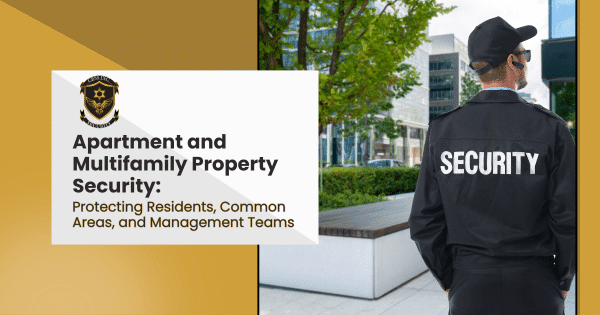
Decide When Onsite Security Officers or Patrol Services Are Appropriate
Not every apartment community needs a standing security officer. Professional coverage becomes more appropriate when documented risks exceed what maintenance, access control, technology, and management procedures can reasonably address alone.
Signs a Property May Benefit From Professional Security
Onsite officers or multifamily security patrol may add value when a property experiences:
- Repeated trespassing or unauthorized entry
- Frequent vehicle-related incidents
- Threats involving residents, visitors, or employees
- Multiple buildings or isolated areas
- High visitor volume
- Active construction or vacant units
- Incidents concentrated during predictable hours
- Recurring gate, parking, or amenity problems
Match the Security Model to the Property’s Actual Risks
The right model depends on the desired outcome:
- Standing officers provide continuous visibility at active posts.
- Lobby officers support visitor screening and access control.
- Foot patrols provide close observation in common areas.
- Vehicle patrols cover larger or multi-building properties.
- Temporary officers support construction, emergencies, or heightened threats.
- Remote monitoring with defined response procedures can support properties that already have strong camera coverage.
Armed coverage should not be selected simply because it appears stronger. It should follow a documented assessment of credible threats, higher-risk conditions, valuable assets, and operational needs. CBSS offers armed security protection for environments where elevated-risk coverage is justified.
Create Clear Post Orders and Performance Standards
Security officers need written post orders defining:
- Patrol routes and expected frequency
- Priority locations
- Visitor and vendor procedures
- Emergency contacts
- Reporting expectations
- Authority and prohibited conduct
- De-escalation and disengagement procedures
- Conditions requiring management or emergency-service notification
Understanding the broader duties and responsibilities of security officers helps management evaluate performance through documented activity, communication, and incident handling rather than presence alone.
Create an Apartment Security Improvement Plan in Seven Steps
Step 1: Review Incident History and Resident Concerns
Identify recurring locations, time periods, behaviors, access failures, and unresolved maintenance complaints.
Step 2: Conduct a Property-Wide Security Assessment
Inspect entrances, gates, lighting, landscaping, cameras, parking areas, amenity spaces, management offices, and emergency systems.
Step 3: Prioritize High-Risk and High-Impact Deficiencies
Correct broken locks, doors, gates, lighting, and communication failures before investing in more complicated technology.
Step 4: Assign Responsibility and Deadlines
Identify who is responsible for repairs, resident communication, credential management, vendor coordination, training, and incident review.
Step 5: Update Written Policies and Procedures
Document visitor access, deliveries, vendor entry, emergencies, footage requests, employee escalation, and after-hours response.
Step 6: Train Management and Maintenance Teams
Train employees on reporting, de-escalation, emergency communication, access systems, and the limits of their responsibilities.
Step 7: Audit and Adjust the Plan Regularly
Review incidents, equipment performance, resident feedback, patrol reports, and changing property conditions at scheduled intervals.
Strengthen Your Property With a Professional Multifamily Security Assessment
A professional apartment security assessment should examine the property’s layout, incident history, access systems, parking configuration, resident needs, employee procedures, surveillance coverage, and emergency-response plan.
CB Security Solutions develops site-specific security programs rather than relying on generic equipment or staffing packages. Owners, asset managers, HOA boards, and property managers can review available service areas and request a customized plan based on the community’s actual operating conditions.
Schedule a multifamily property security assessment to identify practical improvements, define appropriate coverage, and build a safer environment for residents and employees.