
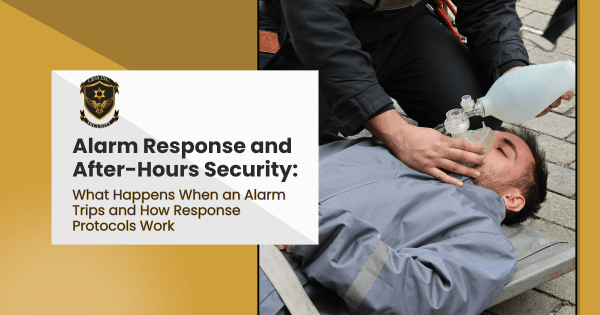
An alarm response service connects an alarm activation to a predefined sequence of verification, communication, dispatch, property assessment, escalation, and reporting. Depending on the alarm, the signal may be reviewed by a monitoring provider and escalated to a property contact, a private security responder, or emergency services.
The exact sequence varies by property, alarm type, jurisdiction, and approved response plan. According to the City of Los Angeles, LAPD handles approximately 6,000 to 7,000 alarm calls each month, and more than 90 percent are determined to be false alarms. That makes accurate verification and disciplined response planning essential. Businesses seeking physical after-hours coverage can review CB Security Solutions’ approach to mobile patrols and property checks.
What Happens When an Alarm Trips After Hours?
When a commercial alarm goes off, the first response usually happens away from the property. A monitoring provider, internal security team, manager, or another authorized party receives the signal and follows the instructions established for that location.
A typical alarm response protocol follows five stages:
- The alarm system generates a signal.
A door contact, motion detector, panic button, fire device, environmental sensor, or equipment alarm may trigger an alert. Each signal can carry a different priority and require a different response. - The signal is identified and reviewed.
The receiving party reviews the alarm type, activation time, location, zone information, and any available verification details. A rear-door alarm at a closed warehouse, for example, may be treated differently from a low-priority equipment notification. - Contact and escalation instructions are followed.
The monitoring provider may call the property, manager, keyholder, or another person listed in the approved contact tree. The goal is to determine whether the activation has a known explanation and identify who should be notified next. - A response decision is made.
Depending on the circumstances, the next step may be contacting a keyholder, dispatching an on-call security patrol, requesting emergency assistance, or documenting a non-emergency condition. - The outcome is documented.
The event should conclude with a record of the activation, calls made, responder observations, actions taken, and final disposition.
Alarm monitoring and physical alarm response are not the same service. Monitoring involves receiving and processing the signal. Physical response involves sending someone to assess observable conditions at the property.
How an Alarm Response Security Guard Handles the Call
Once dispatched, an alarm response security guard needs more than an address. The responder should receive enough information to approach the property carefully and follow the client’s approved instructions.
Receiving the Dispatch and Reviewing Site Instructions
Useful dispatch information may include:
- Property address and alarm zone
- Alarm type and activation time
- Gate, lockbox, or access instructions
- Known hazards and restricted areas
- Authorized property contacts
- Areas approved for visual inspection
- Conditions requiring immediate escalation
Clear instructions reduce uncertainty. They also prevent a responder from entering an area the client has not authorized or approaching a known hazard without preparation.
What an Alarm Response Guard Checks
Before entering, the guard may observe the surrounding area for unusual people, vehicles, sounds, smoke, water, or movement. The inspection may then focus on visible conditions such as:
- Open, unsecured, or damaged doors
- Broken windows
- Cut locks, gates, or fencing
- Unauthorized vehicles
- Suspicious people near the property
- Smoke, water, or environmental hazards
- Evidence of attempted entry
- Changes from the property’s normal condition
Consider a forced rear-gate scenario. The responder arrives, notices a damaged lock and an unfamiliar vehicle near the loading area, and maintains a safe observation point. Rather than entering blindly, the guard follows the escalation plan, contacts the appropriate authorities or manager, preserves the scene, and records what was observed.
A private security guard does not replace police officers, firefighters, or emergency medical personnel. Good response protocols establish when the guard should observe, withdraw, request emergency assistance, control access, or wait for authorized personnel.
Documenting the Response
A useful alarm incident report may include:
- Dispatch, arrival, and clearance times
- Alarm location and type
- Areas visually inspected
- People and vehicles observed
- Signs of damage or attempted entry
- Photographs, when authorized
- Contacts made
- Emergency services requested
- Final property status
Businesses can learn more about the broader duties and responsibilities of security officers and how observation, communication, and documentation support a professional response.
Monitoring Center, Police, and Private Security: Who Does What?
An alarm event may involve several organizations, but their roles are not interchangeable.
| Role | Primary Function | Typical Involvement |
| Alarm monitoring or signal-receiving provider | Receives and processes the electronic signal | Reviews signal information, follows the customer agreement, attempts verification, and initiates approved notifications |
| Private security or mobile patrol responder | Travels to the property and assesses observable conditions | Conducts authorized exterior or site checks, communicates findings, documents the response, and escalates when appropriate |
| Police, fire, or emergency medical services | Responds to suspected crimes, fires, medical emergencies, and other public-safety incidents | Responds according to the incident type, available information, local policies, and dispatch priorities |
The monitoring provider may know that a rear-door sensor activated. The private responder may be able to confirm that the door is damaged. Police may then respond to the report of a possible unlawful entry. Each party contributes a different part of the response.
CBSS offers secure transportation and mobile patrol services that may include property checks, alarm follow-up, escalation, and client reporting. The precise scope should always be established in the service agreement and site instructions.
Verified Response, False Alarms, and Why Details Matter
Verified alarm response means obtaining additional information that suggests an alarm may involve an actual crime, attempted entry, emergency, or other condition requiring action.
Possible verification sources include:
- Multiple sensor activations
- Live or recorded video
- Audio information
- An eyewitness or employee
- A property contact
- An on-site security observation
- Visible property damage
- Evidence of unauthorized entry
The U.S. Department of Justice guide to false burglar alarms explains that private security personnel may conduct on-site verification, assess the situation, and contact police when necessary.
False or accidental alarms can result from ordinary operational problems, including:
- Incorrect arming or disarming
- Doors or windows left unsecured
- Vendors entering outside approved hours
- Outdated call lists
- Animals, weather, or moving objects
- Equipment or sensor problems
- Employees using old access procedures
Businesses should confirm permit requirements, false-alarm charges, and dispatch policies with their alarm provider and local authorities. In Los Angeles, alarm users should review the city’s official alarm permit information.
How to Build an Effective After-Hours Alarm Response Plan
A strong after-hours security plan is written before the alarm occurs. It replaces improvised decisions with clear responsibilities.
Seven Elements of an After-Hours Alarm Response Plan
- Define alarm types and response priorities.
Separate urgent intrusion, panic, fire, environmental, access, and supervisory signals. Not every notification should trigger the same sequence. - Create an accurate contact tree.
List primary managers, backup contacts, keyholders, property management representatives, and emergency escalation points. - Provide clear access instructions.
Document gates, lockboxes, access codes, restricted rooms, hazardous areas, and approved entry limitations. Avoid leaving responders to guess. - Identify high-risk areas.
Mark loading docks, rear entrances, rooftops, storage rooms, equipment yards, utility spaces, and areas with prior incidents. - Establish escalation thresholds.
Define what should trigger manager notification, police or fire contact, scene preservation, withdrawal, or additional security support. - Set reporting expectations.
State who receives the report, what must be recorded, and how urgent findings should be communicated. - Test and update the plan.
Review it after staffing changes, construction, access modifications, repeated false alarms, tenant turnover, or an actual incident.
A warehouse, for example, may require exterior door checks, loading-dock observations, vehicle documentation, and a no-entry rule unless police or an authorized manager is present. A retail center may prioritize storefront glass, rear delivery corridors, rooftop access, and shared parking areas. CBSS provides additional guidance on warehouse security solutions and retail security and incident response.
When Mobile Alarm Response Makes Sense
Mobile alarm response can be useful for properties that close overnight, cover large areas, or do not require a guard at one fixed post throughout the entire shift.
Properties that may benefit include:
- Warehouses and distribution facilities
- Construction sites
- Retail centers
- Office buildings
- Apartment and HOA communities
- Equipment yards
- Parking facilities
- Multi-location business portfolios
Mobile patrol can provide scheduled checks, semi-random visibility, and dispatchable response across one or more locations. A standing security post may be more appropriate when the property needs continuous access control, immediate on-site intervention, visitor processing, or regular interaction with employees and the public.
Some locations benefit from a layered model. Mobile patrol may cover parking areas and perimeter points while an on-site officer manages the lobby, gate, or occupied portion of the property.
Questions to Ask an Alarm Response Security Provider
A business should evaluate more than the monthly price. Ask:
- Are you properly licensed to provide private security services?
- What geographic area can your patrol team cover?
- How are dispatch instructions and site information maintained?
- What factors affect response availability and timing?
- What areas will the responding officer inspect?
- When will police, fire, management, or a keyholder be contacted?
- What documentation will the client receive?
- How are protocols reviewed after an incident or false alarm?
California businesses can check company and individual credentials through the state’s BSIS license-verification system.
No provider should promise a guaranteed response time unless that promise is supported by the written agreement and actual operational capacity. Traffic, responder availability, distance, weather, site access, and simultaneous calls can all affect arrival.
Build a Site-Specific Alarm Response Plan With CBSS
Protecting a property after hours requires more than receiving an electronic notification. The response plan should explain who is contacted, who may be dispatched, what the responder is authorized to inspect, and what conditions require escalation.
CB Security Solutions can help businesses and property managers develop site-specific mobile patrol and alarm-response coverage with clear dispatch instructions, perimeter priorities, escalation standards, and documented reporting. Contact the team to discuss your operating hours, access points, known risks, and after-hours coverage priorities.
Frequently Asked Questions
What is an alarm response service?
An alarm response service sends an authorized security responder to a property after an alarm activation or dispatch request. The responder assesses observable conditions, follows site instructions, communicates findings, escalates emergencies when appropriate, and prepares documentation. Alarm response is different from electronic monitoring, which receives and processes the original signal.
What does a security guard do when responding to an alarm?
The guard reviews dispatch information, approaches carefully, observes the property, checks authorized access points, looks for damage or suspicious activity, contacts designated parties, and documents the outcome. The guard should avoid unsafe entry and request police, fire, or medical assistance when the conditions fall outside private security’s role.
Does private security replace police response?
No. Private security can provide property assessment, visual verification, access control, scene preservation, and communication. Police, firefighters, and emergency medical personnel retain their public-safety roles. A response plan should state when a private responder must disengage, request emergency assistance, or wait for authorities.
What is verified alarm response?
Verified alarm response means obtaining additional information suggesting that an alarm represents a real incident. Verification may come from video, audio, multiple sensors, a witness, a property contact, visible damage, or an on-site guard. The accepted verification method depends on the provider, jurisdiction, and type of alarm.
How can businesses reduce false alarms?
Businesses can train authorized users, secure doors and windows, maintain sensors, update contact lists, coordinate after-hours vendor access, and review repeated activations. Any change to staffing, locks, tenant access, construction, or operating hours should also trigger a review of alarm and escalation instructions.
Is mobile patrol the same as having an on-site guard?
No. A mobile patrol officer moves between properties or checkpoints and may be dispatched when an incident occurs. An on-site guard remains at a designated property or post. Mobile patrol works well for periodic checks and broader coverage, while an on-site guard provides continuous presence and faster intervention at one location.
Takeaway
An effective alarm response protocol turns a signal into an organized sequence: identify the alert, verify available details, follow the contact tree, dispatch the appropriate responder, assess the property, escalate safely, and document the outcome.
The strongest plans are site-specific. They tell every participant what to do before the first after-hours alarm ever sounds.