
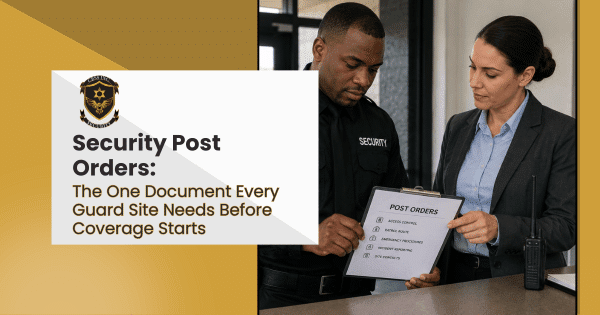
Hiring a security guard is only the beginning of effective coverage. Before the first shift starts, the officer needs to know exactly what they are protecting, what they are expected to do, where their authority begins and ends, and how to respond when something goes wrong.
The U.S. Bureau of Labor Statistics reported approximately 1.26 million security guard jobs in the United States in 2024, but the actual responsibilities behind those jobs can vary dramatically from one property to another. A warehouse guard, construction-site officer, residential patrol guard, and corporate lobby officer may share the same profession while performing very different daily tasks.
That is why strong security coverage starts with security post orders. For businesses evaluating professional security services, post orders provide the operational bridge between a general security plan and the specific actions guards are expected to take every shift.
What Are Security Post Orders and Why Do They Matter?
Security post orders are written, site-specific instructions that define a security officer’s duties, responsibilities, procedures, reporting requirements, and response protocols at a particular property or assignment. They give guards a clear operating framework before they begin working the post.
Good post orders answer practical questions before those questions become problems:
- Where should the guard be positioned?
- What areas should be patrolled?
- How often should patrols occur?
- Who is authorized to enter?
- What should happen when an alarm activates?
- Who should be contacted after an incident?
- What information needs to appear in a report?
- Which situations require escalation to management, supervisors, or emergency services?
Without clear guard site instructions, officers may be forced to interpret expectations on their own. Even an experienced guard cannot automatically know which loading dock should remain locked, which vendors may enter after hours, or which manager should receive an incident report.
What Security Post Orders Tell Guards Before a Shift Begins
The purpose of security guard post orders is not to describe security in abstract terms. They tell the assigned officer how security should work at this property, during this shift.
For example, an office building may emphasize lobby access, employee credentials, visitor sign-in procedures, and after-hours doors. A construction site may focus on equipment, perimeter breaches, authorized contractors, gates, and overnight patrols. A warehouse may require attention to loading areas, trailers, employee entrances, and inventory-sensitive zones.
These responsibilities should complement the broader duties and responsibilities of security officers while translating them into instructions the officer can actually follow.
How Post Orders Turn a Security Plan Into Site-Specific Instructions
A security plan identifies risks. Post orders convert those risks into behavior.
If unauthorized vehicles are a concern, the post orders might establish vehicle-entry procedures. If theft from a loading area is the primary exposure, patrol routes might concentrate on docks and exterior staging areas. If the property experiences significant visitor traffic, instructions may emphasize credentials, sign-in procedures, restricted floors, and escalation.
In other words, security site procedures should reflect what can realistically happen at the property rather than what might happen at any property.
What Should Be Included in Security Guard Post Orders?
Security guard post orders should be detailed enough to remove unnecessary ambiguity without becoming so complicated that guards cannot use them during an active shift.
Guard Responsibilities, Patrol Routes, and Checkpoints
The document should begin with the officer’s basic responsibilities. That can include fixed-post duties, patrol requirements, opening or closing procedures, exterior inspections, parking-lot checks, and monitoring particular assets.
Patrol instructions should identify important locations and, where appropriate, establish frequencies or conditions for checking them. For properties using both stationed officers and vehicle patrol security, instructions should also distinguish what is expected from each form of coverage.
Access Control, Visitor Management, and Restricted Areas
Access procedures should tell the officer who may enter, through which entrance, during what hours, and under what conditions.
A complete set of instructions may address:
- Employee credentials
- Visitor sign-in procedures
- Vendor and contractor access
- Delivery protocols
- After-hours entry
- Restricted areas
- Keys, badges, or access cards
- Unauthorized persons
- Tailgating or propped-open doors
- Vehicle access and parking restrictions
CISA’s guidance on facility access control similarly emphasizes aligning access-control measures and procedures with the security needs of the facility.
Emergency Procedures and Escalation Contacts
When an emergency occurs, the officer should not be searching through old emails or guessing whom to call.
Post orders should clearly identify emergency contacts, management contacts, security supervisors, escalation procedures, alarm instructions, and any site-specific responsibilities relevant to foreseeable emergencies.
The document should also fit within the property’s broader emergency planning. OSHA guidance on emergency action plans addresses procedures for reporting emergencies, evacuation responsibilities, contact information, training, and reviewing plans when responsibilities or procedures change.
Security post orders are not a replacement for required workplace emergency planning, but guards should understand how their responsibilities fit within those procedures.
Reporting, Documentation, and Shift Handoff Requirements
Reporting expectations should be just as specific as patrol expectations.
Officers may need instructions covering daily activity reports, incident reports, patrol logs, photographs, alarm notifications, unusual activity, maintenance concerns, and communication with supervisors.
Shift handoffs matter as well. A departing guard should know which information must be passed to the incoming officer so that a security issue does not disappear simply because the shift changed.
What Security Post Orders Should Include
At minimum, site-specific post orders should address:
- Guard duties and post responsibilities
- Patrol routes and checkpoints
- Access-control procedures
- Visitor, vendor, and delivery procedures
- Restricted areas
- Emergency and alarm procedures
- Client and security-company escalation contacts
- Key, badge, or gate-control procedures
- Incident and activity reporting
- Shift-change and handoff expectations
Why Post Orders Should Be Finalized Before Security Coverage Starts
Post orders should be completed before deployment because the first shift is already part of the security operation. It should not function as a rehearsal.
Preventing Confusion During the Guard’s First Shift
Consider two officers arriving at identical properties.
One receives a verbal instruction to “watch the property and make rounds.” The other receives documented instructions identifying authorized entrances, restricted areas, patrol points, emergency contacts, reporting procedures, and what to do when an unauthorized person is encountered.
Both guards may be qualified. Only one has been given the information necessary to perform the assignment consistently from the beginning.
California’s Bureau of Security and Investigative Services identifies prevention, observation, reporting, communication, emergency response, company policies, and contractual obligations among important areas of security-guard training and responsibility. Property-specific instructions help translate those general responsibilities into an actual assignment.
Creating Consistent Expectations Across Different Guards and Shifts
Security coverage often involves multiple officers. Vacations happen. Schedules change. Day and night shifts rotate.
Documented security guard post orders create a common operating standard. Instead of every officer learning the property through informal conversations, the same procedures can follow the post itself.
That consistency becomes particularly important at environments with specialized concerns, such as the risks discussed in CB Security Solutions’ guide to warehouse security solutions or its overview of retail security guards.
Reducing Gaps Between the Client’s Expectations and the Guard’s Actions
Many security problems begin with an expectation that was never clearly communicated.
The property manager assumed the rear gate would be checked every hour. The officer thought it only needed to be checked once. Management expected every unauthorized-entry attempt to generate an incident report. The officer believed only successful entry attempts required reporting.
Post orders replace assumptions with instructions.
Generic Post Orders vs. Site-Specific Security Post Orders
A security post orders template can be useful, but it should provide structure rather than dictate the finished security program.
Why a Security Post Orders Template Is Only a Starting Point
A generic document may include sections for patrols, emergencies, access control, and reporting. That is helpful organizationally.
The problem begins when generic language survives unchanged into deployment.
“Patrol the property regularly” leaves obvious questions. Which areas? How often? At what times? What should the guard look for? What happens when something unusual is discovered?
Strong post orders replace broad instructions with usable procedures.
How Property Risks Should Change Guard Instructions
The site’s physical layout, operating hours, traffic patterns, assets, occupants, and recurring incidents should influence the final instructions.
A meaningful planning process therefore starts with understanding the environment. CB Security Solutions describes its approach as developing protection around the actual operation rather than relying on one-size-fits-all coverage. Businesses can learn more about that approach on the About CB Security Solutions page.
Examples for Offices, Construction Sites, Warehouses, and Residential Properties
Different properties naturally require different priorities.
Office buildings: lobby coverage, visitor verification, employee access, elevators, parking areas, and after-hours procedures.
Construction sites: perimeter fencing, equipment, materials, contractor access, open structures, gates, and overnight activity.
Warehouses: loading docks, trailers, inventory areas, employee entrances, deliveries, and exterior yards.
Residential properties: residents, guests, parking, amenity areas, gates, noise complaints, common areas, and unauthorized visitors.
The uniform may look similar. The assignment is not.
Who Should Create and Approve Security Post Orders?
Effective post orders usually come from collaboration between the client and the security provider.
The Client’s Role in Identifying Site Priorities
Property managers and business owners know their operations. They can identify recurring problems, valuable assets, restricted spaces, unusual operating hours, previous incidents, authorized vendors, employee procedures, and areas that require special attention.
Those details form the operational context behind the post.
The Security Company’s Role in Turning Risks Into Guard Procedures
The security provider can then help translate those priorities into workable security guard procedures.
A straightforward process should look something like this:
- Assess the site. Review entrances, traffic patterns, property layout, sensitive areas, and known concerns.
- Document expectations. Convert those findings into clear duties, access rules, patrol procedures, reporting requirements, and escalation instructions.
- Brief the assigned guards. Make sure officers understand the instructions before assuming the post.
Businesses with multiple environments can also review CB Security Solutions’ industries served to understand how security priorities can change between property types.
Training Guards on Post Orders Before Deployment
Giving an officer a document is not the same as preparing the officer for the assignment.
Before deployment, guards should have an opportunity to review their responsibilities, understand unusual site conditions, clarify escalation procedures, and know where current instructions are maintained.
The goal is simple: when the officer arrives, the property should not feel unfamiliar.
When Should Security Post Orders Be Updated?
Security post orders should be treated as operational documents, not paperwork that gets written once and forgotten.
Changes in Property Layout, Access, or Operating Hours
A review may be appropriate when a property adds or closes an entrance, changes operating hours, modifies parking access, begins construction, adds a restricted area, changes tenant operations, or introduces a new access-control system.
Updating Procedures After Incidents or New Security Risks
An incident can also expose a procedure that needs clarification.
Repeated trespassing near one section of a property, for example, may justify adjusting patrol priorities. Changes to alarms, emergency procedures, equipment, or contact personnel may require corresponding updates.
Keeping Guards Working From the Current Version
Post-order changes matter only if the assigned officers receive them.
A controlled process should identify the current version, remove outdated instructions where practical, communicate material changes, and ensure guards understand responsibilities that have changed.
Post orders should generally be reviewed when:
- The property’s layout changes
- Access procedures change
- Operating hours change
- New tenants or operations arrive
- A recurring security issue develops
- An incident reveals a procedural gap
- Alarm or security systems change
- Emergency contacts change
- Guard responsibilities are modified
Start Security Coverage With Clear Post Orders From Day One
Professional security begins before an officer takes position at the property. The quality of the deployment process matters because guards can only execute expectations that have been clearly communicated.
What to Confirm With a Security Company Before the First Guard Arrives
Before coverage begins, confirm that:
- The site has been assessed
- Guard responsibilities are documented
- Patrol expectations are clear
- Access-control procedures are established
- Emergency contacts are verified
- Reporting requirements are defined
- Assigned guards have been briefed
- A process exists for updating the post orders
If your organization is preparing to deploy guards, consider discussing the property, operating environment, and site-specific security post orders before coverage begins. CB Security Solutions provides security services throughout Southern California and can help businesses evaluate how guard coverage should fit the realities of a particular site.
A guard should never have to guess what the client expects. Strong security post orders turn a broad security objective into clear daily actions, giving officers a repeatable framework for patrols, access control, reporting, emergencies, and escalation from the first shift forward.