
When a labor strike begins, the worksite changes fast. Emotions rise, routines break, cameras come out, and every decision suddenly matters more.
In that moment, security is not there to “win” the dispute. Security is there to protect people, preserve order, keep access routes workable, and reduce the chance that a tense situation turns into a dangerous one.
For employers preparing for possible disruption, a disciplined security plan matters just as much as an operations plan or legal plan.
A well-briefed team can support continuity without crossing lines that make the situation worse. If your site may require a higher-risk posture based on credible threats, access concerns, or prior incidents, CB Security Solutions can also help evaluate whether a tailored armed security protection plan is appropriate as part of a broader response. And the stakes are real: OSHA reports that violent acts caused 740 fatal workplace injuries in the United States in 2023.
What “Strike Security” Is, and What It Is Not
The first mistake many companies make is conceptual. They treat strike security like crowd control. That is the wrong starting point.
Strike security is not about punishing employees, intimidating picketers, or trying to outmuscle a labor dispute. It is a risk-management function during a legally sensitive event. That means the team on site has to understand a simple but crucial distinction: labor activity may be protected, but violence, threats, property damage, and physical blockage of access routes can move the situation into a very different category.
The practical takeaway is this: security should focus on conduct, not viewpoint. People holding signs, chanting, gathering near an entrance, or documenting the scene are not automatically a security problem. A blocked gate, a threatened driver, a damaged vehicle, or an escalating confrontation may be.
That is why pre-strike briefing matters so much. Before the first picket sign appears, the client should already have alignment among management, HR, labor counsel, site leadership, and the security supervisor. Everyone needs the same definitions, the same chain of command, and the same understanding of what security is being asked to do.
Helpful starting points for management include reviewing the National Labor Relations Board’s guidance on the right to strike and picket and the NLRB’s broader summary of the right to strike. Those resources are a reminder that the legal reality is not simplistic. Some strikes and picketing are protected. Some conduct is not. Some industries also have additional notice rules. Security plans that ignore those distinctions create risk for the client before the first incident report is even written.
The best strike detail begins with humility. A good team knows it is walking into a high-friction environment and that professionalism, restraint, and consistency matter more than bravado.
What Security Teams Actually Do During a Strike
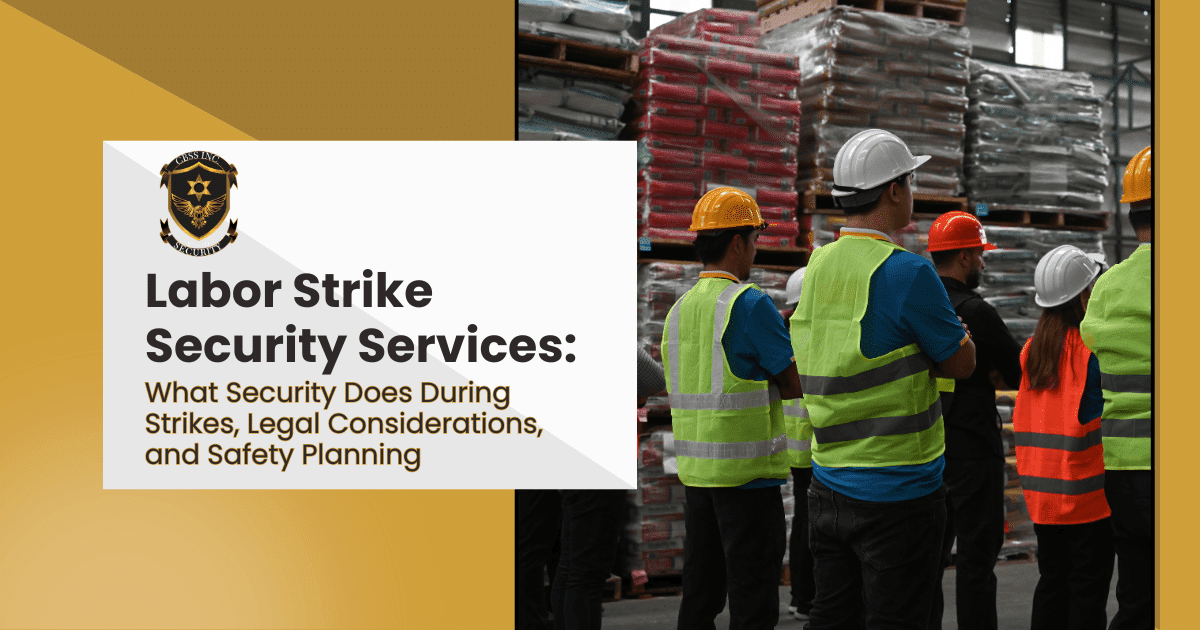
Once the detail begins, the work itself is less theatrical than many people imagine. Good strike security is structured, repetitive, and calm. It is about keeping the site workable hour by hour.
The core functions usually include:
- Access management at gates, docks, garages, and employee entrances
- Traffic flow for staff, vendors, deliveries, and emergency vehicles
- Perimeter coverage to identify hot spots before they spread
- Observation and incident detection rather than unnecessary confrontation
- Escort procedures for employees or vendors when conditions justify it
- Immediate reporting up the chain of command when objective trigger events occur
A strong team is not wandering around improvising. It is operating from post orders. That means designated posts, reporting intervals, escalation thresholds, and communication rules are already in place.
For example, access management during a strike often means separating pedestrian flow from vehicle flow, preserving one clear route for deliveries or emergency response, and keeping loading zones from becoming choke points. At some sites, it may also mean verifying who is entering restricted areas without turning every interaction into an argument. At others, it means visible patrol presence near parking lots and side entrances so problems do not migrate away from the main gate and become harder to monitor.
This is where clients often underestimate the value of disciplined staffing. A site with unclear posts and uneven coverage tends to create blind spots. Blind spots create rumors. Rumors create overreactions. By contrast, a clear plan keeps the temperature lower:
- One supervisor controls the detail
- Officers know exactly which entrances they own
- Reports go through one chain of command
- Significant events are documented as they happen, not reconstructed later
- Law enforcement contact, if needed, happens through a designated decision-maker
The best strike coverage often looks uneventful from the outside. That is not a sign that security was unnecessary. It is often the sign that the team was positioned well, briefed well, and disciplined enough not to inflame a hard day.
If your organization wants a site-specific plan before tensions escalate, contact CB Security Solutions to build coverage around your layout, operating hours, and risk profile.
De-Escalation and Neutral Posture Matter More Than Force
In labor-related security work, tone is operational. The way an officer stands, speaks, gestures, and responds can either preserve calm or become the spark.
A neutral posture does not mean passive. It means controlled. Officers should not debate labor issues, mock picketers, insert themselves into arguments they do not need to join, or make promises they do not have authority to make. Their role is to communicate boundaries, give lawful instructions when necessary, and report facts up the line.
That neutral posture should be matched with a simple escalation ladder. In practice, that often looks like this:
- Observe and assess
- Use calm verbal communication
- Restate site boundaries or access rules clearly
- Call a supervisor early when tension rises
- Involve law enforcement when predefined safety thresholds are met
This matters because strike environments are emotionally loaded. People may already feel unheard, angry, embarrassed, or watched. An officer who acts as if every raised voice is a personal challenge can worsen the situation in seconds. An officer who stays steady can often help keep one heated interaction from turning into a crowd event.
OSHA’s workplace violence resources consistently point back to prevention planning, training, and worksite-specific controls. That is the right frame here, too. Security teams on strike details should know how to spot behavioral shifts, recognize when a crowd is tightening around a person or vehicle, and move from presence to action only when facts justify it.
It is also important to say what many firms do not say clearly enough: not every strike detail should be staffed the same way. Some sites need a discreet, unarmed, highly communicative presence. Some need vehicle patrol support. Some may justify a more robust posture because of credible threats, prior violence, or high-value assets. The right answer should come from the risk assessment, not from ego.
That is why a tailored armed security protection strategy, when appropriate, should be narrowly scoped, well supervised, and fully integrated into the legal and operational plan. Done carelessly, a heavy posture can raise tension. Done thoughtfully, it can protect vulnerable access points while the rest of the detail remains measured and professional.
Site Planning and Documentation Are What Protect the Client Later
During a strike, memory becomes unreliable very quickly. People talk over one another, video clips circulate without context, and small incidents grow in the retelling. That is why documentation is not paperwork for its own sake. It is protection.
Before coverage begins, the site should be mapped with practical precision. Security should know:
- Which entrances must remain operational
- Which routes are reserved for deliveries or emergency vehicles
- Where employees should park or be escorted if conditions change
- Where supervisors stage and where relief officers check in
- Which cameras cover the most sensitive approaches
- What constitutes an incident that requires immediate escalation
A good written plan should also answer basic but essential questions. Who calls law enforcement? Who speaks to management? Who preserves video? Who logs witness names? Who documents blocked access, how long it lasted, and what warnings were given?
When an event happens, good reporting focuses on observable facts. Not assumptions. Not opinions. Not loaded language.
Strong incident documentation usually includes:
- Exact time and location
- Names or descriptions of the involved parties
- What was seen or heard directly
- Whether access was blocked and for how long
- Whether threats, property damage, or physical contact occurred
- Which supervisor was notified and when
- Whether video, photos, or witness statements were preserved
OSHA’s workplace violence fact sheet emphasizes reporting, logging, investigation, training, and coordination with public safety where needed. That logic applies directly to strike coverage. If an incident becomes a legal issue later, the client will be helped far more by a clean time-stamped log and preserved evidence than by ten passionate opinions after the fact.
This is one reason experienced clients prefer security partners with disciplined reporting habits. Good officers do not just “be there.” They create a reliable record of what happened, what was done, and why.
Common Mistakes That Increase Risk, and How CB Security Solutions Approaches Strike Coverage
Most strike-related failures do not start with one dramatic mistake. They start with a series of small ones.
An unclear post order. A supervisor who is hard to reach. Officers receiving mixed messages from management and HR. Staffing that looks strong at 8:00 a.m. and thin by 2:00 p.m. A team that documents the major confrontation but not the smaller warning signs that came before it.
The most common risk multipliers usually look like this:
- Over-aggressive posture at the gate
- Poorly defined authority for officers on site
- Inconsistent response from shift to shift
- Failure to coordinate with counsel and operations in advance
- Weak note-taking and delayed incident reporting
- No clear plan for preserving video or witness information
CB Security Solutions approaches strike coverage with a calmer, more disciplined model. The objective is not noise. It is control. That starts with chain-of-command leadership, clear post orders, and professional conduct standards that hold up under pressure. It continues with consistent supervisor oversight, fast communication, and reporting that is organized enough to be useful when leadership needs to make decisions quickly.
A serious strike detail should feel managed, not improvised. That means staffing that fits the footprint, response procedures that officers can actually execute, and a documented operating rhythm that does not disappear once the first tense interaction occurs.
For clients, that brings practical benefits. You get cleaner escalation. Better logs. Fewer contradictory accounts. Better coordination with management and counsel. And when outside agencies need to be contacted, you are doing so from a position of documented facts rather than panic.
If your company is preparing for a possible strike, picketing activity, or a high-tension labor event, contact CB Security Solutions to build a site plan that is lawful, professional, and operationally sound.
Takeaway
Strike security works best when it stays disciplined, neutral, and well-documented. The right team protects people and property, keeps access routes safer, and gives management clear information without turning security into a new source of conflict.
In a labor dispute, professionalism is not a soft skill. It is the strategy.