
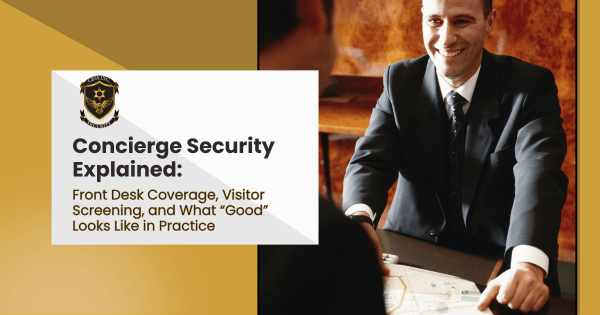
Concierge security combines a professional front-of-house presence with access control, visitor processing, observation, documentation, and incident-response responsibilities. The goal is not to make every guest feel suspicious. It is to maintain a welcoming environment while making sure the property’s entry procedures are followed consistently.
The U.S. Bureau of Labor Statistics reported that security guards held approximately 1.3 million jobs in 2024, underscoring how widely security personnel are employed across offices, residential communities, healthcare facilities, retail properties, and hospitality settings. Understanding the broader duties and responsibilities of security officers can help property managers determine what front desk coverage should include, how visitors should be screened, and what high-quality concierge security looks like in practice.
What Is Concierge Security?
Concierge security is a public-facing security service that brings hospitality, access management, and incident response together at a property’s front entrance or reception area. The officer helps people navigate the building while protecting the rules that determine who may enter, where they may go, and what should happen when something unusual occurs.
A well-designed concierge security position generally includes three functions:
- Hospitality: Greeting visitors, answering basic questions, providing directions, and creating a professional first impression.
- Access management: Confirming authorization, monitoring entrances, issuing visitor credentials, and following established entry procedures.
- Security response: Observing unusual activity, documenting incidents, notifying management, and responding according to post orders.
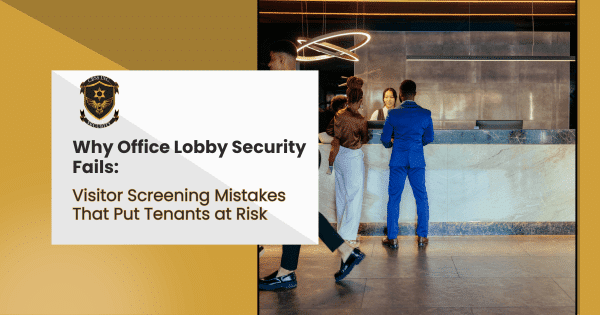
Consider three people entering an office lobby. An expected client may be welcomed, confirmed, and directed upstairs. An unknown visitor may be asked to wait while authorization is verified. A person reporting a medical emergency may require an immediate call for assistance and coordination with emergency responders.
The setting is the same. The appropriate response changes with the circumstances.
Concierge Security vs. a Traditional Receptionist
A traditional receptionist generally focuses on communication, scheduling, administrative assistance, directions, and customer service. Concierge security personnel may provide similar front-facing assistance, but they are also assigned security-related responsibilities.
Those responsibilities may include monitoring access points, identifying unusual behavior, following visitor-screening procedures, preparing security reports, and escalating concerns through an established chain of command.
This does not mean receptionists are incapable of responding appropriately during an emergency. The distinction comes down to assigned duties, training, authority, supervision, and written procedures.
Concierge Security vs. a Traditional Security Guard
Concierge security does not remove the underlying security responsibility. It adapts that responsibility to a setting where visitors, residents, employees, patients, or customers expect a polished experience.
A traditional security post may emphasize patrols, perimeter control, deterrence, or asset protection. Concierge coverage places greater emphasis on professional communication, appearance, discretion, visitor management, and front desk awareness.
Properties with broader risks may combine concierge coverage with other professional security services, such as patrol support, executive protection, or specialized armed coverage. The correct structure depends on the property, operating hours, access points, visitor volume, and risk profile.
What Front Desk Security Coverage Should Include
Front desk security should be built around specific responsibilities, not vague instructions to “watch the lobby.” During a normal shift, the officer should know what must be monitored, which procedures must be followed, and when management needs to be contacted.
Core front desk security responsibilities commonly include:
- Greeting and directing authorized visitors
- Monitoring entrances and controlled doors
- Confirming visitor and vendor authorization
- Managing badges, credentials, keys, or access cards
- Recording routine activity and unusual events
- Responding to incidents and notifying the correct personnel
Welcoming and Directing Authorized Visitors
Professional lobby security begins with acknowledgment. Visitors should not be left standing at the desk wondering whether anyone has noticed them.
The officer may ask whom the person is visiting, confirm the purpose of the visit, contact the host, and explain the property’s check-in procedures. Directions should be clear, polite, and limited to areas the visitor is authorized to access.
A good concierge officer does not turn a routine arrival into an interrogation. The interaction should feel orderly and professional while still satisfying the property’s requirements.
Monitoring Entrances and Controlling Access
Front desk security personnel may monitor primary entrances, side doors, elevators, tenant directories, cameras, keycards, intercoms, and other approved access-control systems.
The officer should follow the property’s authorization process rather than relying on assumptions. Recognizing someone does not necessarily mean that person is authorized to enter on every occasion.
Employees may forget credentials. Former contractors may return unexpectedly. Regular delivery drivers may arrive outside approved hours. Consistent procedures help prevent familiarity from quietly replacing access control.
Managing Deliveries, Vendors, and After-Hours Arrivals
Different visitor categories may require different procedures. A scheduled contractor should not necessarily be processed in the same manner as a food delivery driver, courier, employee, resident guest, or after-hours maintenance vendor.
Written site instructions should explain:
- Where deliveries should be received
- Whether vendors must be pre-approved
- Which visitors require escorts
- Who may approve after-hours entry
- How failed host confirmations should be handled
- Where visitors may wait without obstructing operations
Properties with large parking areas or multiple buildings may also benefit from pairing lobby coverage with vehicle patrol security to monitor exterior areas that cannot be observed from the front desk.
How a Professional Visitor-Screening Process Works
Visitor screening should follow a repeatable process. The officer should not be forced to invent a new response every time someone approaches the desk.
A practical visitor check-in process may include:
- Acknowledge the visitor.
- Determine the visitor’s identity and purpose.
- Identify the person, tenant, department, or resident being visited.
- Confirm authorization through an approved method.
- Record required visit information.
- Issue a badge or temporary credential when necessary.
- Grant, delay, escort, redirect, or deny access according to procedure.
Step 1: Determine the Visitor’s Identity and Purpose
The first step is understanding who the person is, whom they are visiting, and why they need access.
The amount of information required may vary. A public-facing medical office may operate differently from an executive suite, apartment building, warehouse office, or corporate campus. Officers should collect the information required by the property’s approved procedures without requesting unnecessary personal details.
Step 2: Confirm Authorization
Authorization may be confirmed through:
- A pre-registration list
- Direct host confirmation
- A tenant or employee directory
- An approved vendor schedule
- A work order
- A valid credential
- Written management instructions
Familiarity should not automatically override these methods. An officer who routinely admits recognizable visitors without verification may create an exception that other shifts cannot apply consistently.
When a host cannot be reached, the officer should know whether to ask the visitor to wait, contact another authorized representative, redirect the visitor, or decline entry.
Step 3: Register and Identify the Visitor
After authorization is confirmed, the officer may record the visitor’s name, host, arrival time, purpose, credential number, and departure time. The visitor may also receive a temporary badge identifying where access is permitted.
Visitor information should be collected and retained only as required by the property’s policies and applicable rules. Organizations using digital check-in systems should also review how visitor data is stored, accessed, and deleted. CB Security Solutions’ privacy policy provides additional information about its own handling of personal information.
Step 4: Grant, Delay, Escort, or Deny Access
Visitor screening is not limited to a yes-or-no decision. Depending on the situation, an officer may:
- Grant access to an approved area
- Ask the visitor to wait for confirmation
- Arrange for the host to meet the visitor
- Require an escort
- Redirect a courier to a delivery entrance
- Contact management for further instructions
- Deny access under established procedures
The officer should explain the outcome calmly without debating confidential policies or improvising exceptions.
What Good Concierge Security Looks Like in Practice
Building managers should evaluate concierge security through observable conduct, not appearance alone.
| Observable Standard | What It Looks Like |
| Alert presence | The officer acknowledges arrivals and watches entrances rather than remaining distracted |
| Consistent access control | The same authorization rules are followed across visitors and shifts |
| Professional communication | Instructions are delivered clearly, respectfully, and confidently |
| Useful reporting | Logs and reports explain what occurred, what action was taken, and who was notified |
| Emergency readiness | The officer knows alarm procedures, emergency contacts, exits, and escalation steps |
| Reliable supervision | Performance issues are identified, corrected, and followed through |
Professional Without Becoming Passive
A polished uniform and friendly greeting are only the beginning. An officer who avoids verification, overlooks propped doors, ignores unusual behavior, or hesitates to enforce established procedures is not providing effective front desk security.
Courtesy and attentiveness must coexist. Good service means applying rules calmly, respectfully, and consistently, even when the conversation becomes uncomfortable.
Firm Without Creating Unnecessary Conflict
Firm communication does not require hostility. Effective officers use neutral language, active listening, simple explanations, and appropriate physical distance.
Rather than accusing someone of wrongdoing, the officer can explain the procedure:
“I am unable to provide access until the host confirms the visit. You are welcome to wait here while I try to reach them.”
Early communication often prevents frustration from escalating. Officers should also understand when to step back, request supervisory assistance, or contact emergency services. Concierge personnel are not substitutes for law enforcement and should remain within their training, authority, post orders, and company procedures.
Reliable Documentation and Communication
A good security report should answer:
- What happened?
- When and where did it happen?
- Who was involved?
- What action was taken?
- Who was notified?
- What follow-up remains necessary?
Shift logs, incident reports, pass-down notes, and management notifications help the next officer understand unresolved concerns. Strong supervision, including clearly assigned responsibilities for security leads and security guard lieutenants, can help prevent information from disappearing between shifts.
Preparedness for Emergencies and Unusual Events
Front desk officers may be among the first people to notice or receive reports of fire alarms, medical emergencies, threatening behavior, suspicious activity, access-system outages, or power failures.
The Occupational Safety and Health Administration’s workplace-violence guidance encourages employers to assess workplace risks and develop prevention measures appropriate to the worksite. Similarly, Ready.gov’s business emergency-planning guidance emphasizes advance planning, communication, warning procedures, and coordination with emergency services.
Concierge officers should be familiar with site-specific emergency contacts, notification chains, exits, assembly areas, and procedures for directing responders.
Common Signs That Front Desk Security Is Underperforming
A lobby can appear orderly while important procedures quietly break down. Common warning signs include:
- Familiar visitors being admitted without verification
- Undocumented exceptions becoming routine
- Different officers enforcing different rules
- Excessive personal-device use
- Failure to acknowledge arriving visitors
- Controlled doors being left unattended
- Incomplete visitor logs or incident reports
- Delayed management notifications
- Officers being assigned unrelated administrative work that distracts from access control
- Repeated complaints without documented corrective action
An isolated mistake may call for coaching. A recurring pattern may indicate unclear post orders, inadequate training, weak supervision, poor staffing, or a mismatch between the property’s expectations and the coverage being provided.
How to Build and Maintain an Effective Concierge Security Program
Effective concierge security depends on more than selecting a personable officer. The program must be designed around the property and reinforced over time.
Use a four-part framework:
Assess
Identify entrances, restricted areas, visitor categories, delivery patterns, peak arrival periods, recurring incidents, emergency routes, and after-hours conditions.
Document
Create written post orders covering routine duties, visitor exceptions, approval authority, prohibited actions, emergency contacts, report requirements, and escalation procedures.
Train
Prepare officers for the property’s access systems, expected visitor interactions, customer-service standards, emergency procedures, and reporting expectations. Environments such as healthcare facilities may require additional attention to de-escalation and visitor behavior, as discussed in CBSS’s guide to hospital security coverage.
Review
Measure performance through punctuality, visitor-processing accuracy, report completeness, notification times, tenant feedback, supervisor inspections, and completion of corrective actions.
Technology can support this framework through cameras, intercoms, badge systems, digital visitor platforms, and emergency communication tools. It should reinforce professional judgment and established procedures, not replace them.
Which Properties Benefit Most From Concierge Security?
Concierge security can be especially valuable in environments where public access, professional presentation, and security responsibilities meet.
- Corporate offices and executive environments: Helps manage employees, interviews, scheduled visitors, vendors, and executive arrivals. Higher-profile environments may also benefit from broader physical security for executives.
- Apartments, condominiums, and residential communities: Supports resident guests, deliveries, contractors, amenity access, parking concerns, and after-hours arrivals.
- Medical offices: Helps organize patient and visitor flow while supporting emergency communication and de-escalation procedures.
- Hotels and hospitality properties: Provides a discreet security presence without undermining the guest experience.
- Campuses and mixed-use developments: Helps manage multiple visitor categories, entrances, tenants, and access expectations.
Property managers can review CB Security Solutions’ industries served and Southern California service areas when considering whether site-specific coverage is appropriate.
Questions to Ask Before Hiring a Concierge Security Company
Use these questions when reviewing a proposal or participating in a security consultation:
- How are officers selected for public-facing assignments?
- What security and customer-service training is provided?
- How are site-specific post orders developed?
- How is visitor-screening performance audited?
- Who supervises the officers?
- How are call-offs and uncovered shifts handled?
- What reports will property management receive?
- How are recurring concerns investigated and corrected?
Vague answers about supervision, training, reporting, or relief coverage may indicate that the provider is selling personnel rather than a managed security program.
Strengthen Your Front Desk Without Sacrificing the Visitor Experience
An effective concierge security program begins by evaluating entrances, visitor flow, operating hours, emergency procedures, service expectations, and recurring concerns. From there, staffing, visitor-screening procedures, post orders, technology, and reporting standards can be matched to the property.
CB Security Solutions provides security coverage designed around professional presence, communication, documentation, and site-specific operating needs. Learn more about the CBSS team or request a concierge security assessment for your property.
Good concierge security does not force a property to choose between hospitality and control. It creates a front desk experience that is welcoming when circumstances are routine, firm when procedures must be enforced, and prepared when something unexpected occurs.