
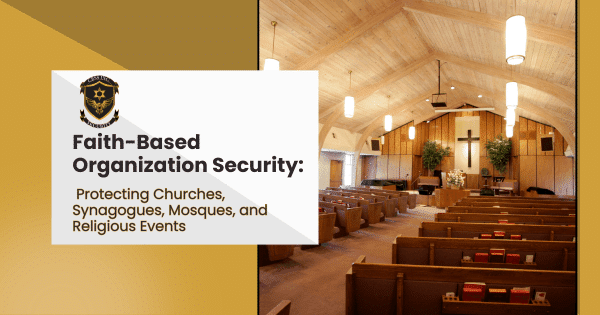
Faith-based organizations are built around openness, service, and human connection. Those qualities should be preserved, but they must be supported by thoughtful procedures that protect congregants, clergy, staff, volunteers, children, and visitors.
Federal data recorded 11,679 reported hate crime incidents involving 14,243 victims in 2024, with religion accounting for 23.5 percent of victims in single-bias incidents. These figures reinforce the importance of treating faith-based organization security as an ongoing responsibility rather than a reaction to a single threat. A customized plan from CB Security Solutions can help religious leaders balance hospitality with practical, proportionate protection.
Why Faith-Based Organizations Face Distinct Security Risks
Faith-based organization security is the coordinated use of people, procedures, facility improvements, and technology to protect a religious community while preserving its welcoming character.
Religious facilities often face a distinctive combination of risks:
- Open or lightly controlled public access
- Predictable worship and event schedules
- Large gatherings involving multiple age groups
- Reliance on volunteers for important operational roles
- Valuable equipment, donations, records, and religious items
- Exposure to disruptive conduct, targeted threats, and emergencies
A religious facility security plan should address routine concerns such as theft and medical incidents while also preparing the organization for serious, less frequent events.
Balancing Open Access With Congregational Safety
Churches, synagogues, mosques, and other religious institutions rarely operate like private offices. They welcome unfamiliar visitors, provide community assistance, host public gatherings, and often allow people to enter without appointments.
The goal is not to turn the facility into an intimidating checkpoint. The goal is to create structure behind the welcome. Trained greeters can observe arrivals while offering assistance. Secondary doors can be secured during services without obstructing emergency exits. Staff can follow clear reporting procedures when behavior creates concern.
Hospitality and security are not opposing values. When implemented carefully, good security reduces uncertainty and allows religious leaders to focus on worship, education, and community service.
Common Threats Facing Religious Facilities
Religious organizations should prepare for more than deliberate violence. Common church security threats, synagogue security risks, and mosque security risks may include:
- Theft, vandalism, trespassing, and property damage
- Disputes involving members, visitors, or former employees
- Harassment, stalking, or threatening communications
- Hate-motivated incidents and targeted violence
- Medical emergencies and missing children
- Fires, severe weather, and utility failures
- Parking conflicts, crowd congestion, and vehicle incidents
Leaders should review the federal government’s hate crime facts and statistics when evaluating the wider threat environment. Local incident history, community concerns, and law-enforcement intelligence should also inform planning.
Conduct a Professional Security Risk Assessment
A religious facility security assessment identifies vulnerabilities before an organization spends money on cameras, guards, alarms, or construction. It connects recommendations to actual operations instead of relying on fear or assumptions.
A practical house of worship risk assessment follows a clear process:
- Map the property, buildings, entrances, and gathering areas.
- Observe operations during worship services and regular programs.
- Review previous incidents, threats, and near misses.
- Identify people, spaces, and assets requiring additional protection.
- Rank risks by likelihood, severity, and available resources.
- Assign corrective actions, responsible parties, and target dates.
The assessment should produce a prioritized roadmap, not simply a list of everything that could go wrong.
Review the Property, Perimeter, and Surrounding Area
Begin with the physical environment. Map public entrances, emergency exits, parking lots, playgrounds, classrooms, administrative offices, utility areas, and outdoor gathering spaces.
Look for:
- Poorly illuminated walkways and parking areas
- Landscaping or structures that create concealment
- Doors that are routinely propped open
- Isolated offices or classrooms
- Unmonitored routes between buildings
- Areas where children or older adults may become separated
- Barriers that could delay emergency responders
Religious property security should also account for neighboring businesses, traffic patterns, public transit stops, demonstrations, homeless outreach activities, and surrounding crime conditions.
Evaluate Operations, Attendance, and Event Schedules
A nearly empty facility on a weekday morning presents different concerns than a holiday service attended by hundreds of people. The assessment should examine normal attendance, high-traffic periods, children’s programs, schools, food distribution, counseling, weddings, funerals, and community events.
Review how the organization handles:
- Cash donations and financial records
- Keys, badges, and alarm codes
- Child check-in and authorized pickup
- Vendors, contractors, and deliveries
- Religious artifacts and valuable equipment
- After-hours programs and lone workers
- Clergy members who may receive threats or unwanted contact
Organizations can explore CBSS security services and the different industries served when considering how professional protection can fit their operations.
Prioritize Risks by Likelihood and Potential Impact
Not every vulnerability requires the same response. A frequently unlocked office door may be easier to correct than a poorly designed parking area, but both should be documented.
Separate routine concerns from low-frequency, high-impact threats. Then rank each issue according to:
- How likely it is to occur
- How severely it could affect people or operations
- Whether existing controls reduce the risk
- How quickly the organization can make an improvement
- Who is responsible for completing the corrective action
A professional assessment can help leadership avoid disconnected purchases and concentrate resources where they can make the greatest practical difference.
Build a Written Security and Emergency Action Plan
A security assessment identifies the problems. A written church security plan or religious organization emergency plan establishes what people should do about them.
The plan should be clear enough for staff and volunteers to use under stress. It should identify authority, communication methods, protective actions, evacuation routes, reunification locations, and procedures for contacting emergency services.
Essential Elements of a Faith-Based Security Plan
- Defined leadership and backup roles
- Emergency contact information
- Facility maps and evacuation routes
- Medical, fire, weather, and security procedures
- Lockdown and shelter-in-place guidance
- Child and vulnerable-adult accountability systems
- Internal and public communication protocols
- Incident reporting and evidence-preservation procedures
- Training, exercise, and review schedules
The federal Guide for Developing High-Quality Emergency Operations Plans for Houses of Worship provides additional planning considerations for hazards that may occur before, during, and after an emergency.
Define Leadership Roles and Decision-Making Authority
Appoint a security coordinator or committee leader who can maintain the plan, schedule training, and communicate with clergy and administrators. Define the responsibilities of clergy members, facilities staff, ushers, teachers, greeters, and security personnel.
The plan should specify who has authority to:
- Call 911 or request medical assistance
- Initiate an evacuation or shelter-in-place response
- Secure interior rooms or public entrances
- Communicate with congregants and families
- Meet responding law-enforcement personnel
- Preserve video, messages, and incident records
Every critical role should have a backup. Services and events should not depend on one person being present.
Create Procedures for Common Emergency Scenarios
Written procedures should address events the organization is reasonably likely to face, including:
- Medical emergencies
- Fire and evacuation
- Severe weather
- Missing children or vulnerable adults
- Suspicious packages
- Threatening calls, emails, or social-media messages
- Disruptive individuals
- Violent incidents
- Law-enforcement activity near or inside the facility
Procedures should be short, direct, and role-specific. During an emergency, people need clear actions, not lengthy policy language.
Establish Communication and Accountability Systems
Decide how leaders will communicate when normal conversation is not practical. Options may include two-way radios, group messaging platforms, mobile phones, public-address systems, and predetermined emergency language.
Plain-language alerts are often easier to understand than complicated codes. The plan should also establish child-release procedures, attendance accountability, assembly areas, and family reunification locations.
Communication systems should be tested during normal operations. A radio stored in a cabinet or an outdated phone list provides little value during an actual emergency.
Strengthen Access Control Without Undermining Hospitality
Church access control and religious facility entrance security should make movement understandable and observable. Visitors should know where to enter, where to request help, and which areas are private.
| Welcoming Practice | Corresponding Security Control |
| Friendly greeters at the main entrance | Trained observation and rapid communication |
| Clear signs and visitor directions | Reduced wandering into restricted spaces |
| Open public worship areas | Secured offices, classrooms, and storage rooms |
| Assistance for new visitors | Respectful orientation and behavioral awareness |
| Accessible entrances | Monitored routes that remain code compliant |
Limit and Monitor Active Entrances
Designate one or more primary public entrances during services. Secondary doors may be locked or monitored from the inside when permitted, but emergency exits must remain functional and compliant with applicable fire and building requirements.
Position trained greeters where they can see arrivals without blocking movement. Greeters should know how to welcome visitors, recognize behavior that may require attention, and discreetly contact the security coordinator.
Separate Public, Staff, and Children’s Areas
Offices, counseling rooms, schools, childcare spaces, storage rooms, and financial offices should not be treated as public areas simply because they are inside a religious facility.
Use appropriate controls such as:
- Keys or electronic credentials
- Staff and volunteer identification
- Child check-in records
- Authorized pickup procedures
- Locked storage for financial documents and valuables
- Visitor escort policies
Children’s ministry security should be consistent during routine programs, special events, and crowded holiday services.
Develop a Respectful Visitor Management Process
Visitor management for churches and other worship facilities should focus on conduct, context, and access needs. It should never rely on race, religion, disability, clothing, national origin, or appearance.
Greeters can welcome unfamiliar visitors, explain the facility layout, and direct them to the appropriate space. When conduct creates concern, staff should follow a documented escalation procedure rather than improvising.
Professional security personnel should understand the organization’s culture and expectations. Their presence should support the religious environment, not dominate it.
Use Physical Security Measures and Technology Effectively
Security systems for churches and other religious institutions work best when they support a broader plan. Cameras cannot replace trained people. Guards cannot compensate for unclear procedures. Locks cannot help when doors are routinely left open.
Prioritize improvements in three levels:
- Essential measures: Lighting, functional locks, clear exits, emergency equipment, and communication.
- Enhanced measures: Cameras, intrusion alarms, electronic access control, and monitored panic systems.
- Event-specific measures: Temporary guards, mobile patrols, barriers, traffic control, and additional medical support.
Improve Lighting, Visibility, and Building Layout
Illuminate entrances, walkways, parking areas, playgrounds, and gathering spaces. Replace failed bulbs promptly and trim landscaping that blocks cameras or creates concealment.
Maintain clear sightlines around reception areas and entrances. Where vehicles approach crowded pedestrian areas, consider properly designed barriers, planters, bollards, or controlled traffic routes.
Facility changes should be reviewed for accessibility, fire safety, and local code compliance before installation.
Install Cameras, Alarms, and Access-Control Systems
Church security cameras can provide awareness, support investigations, and help leadership review incidents. Coverage commonly includes entrances, parking lots, hallways, cash-handling locations, and areas containing important assets.
Organizations should establish:
- Authorized access to recordings
- Appropriate video-retention periods
- Procedures for exporting incident footage
- Cybersecurity protections for connected systems
- Privacy safeguards for counseling and worship areas
- Compliance with applicable notice and recording laws
Intrusion alarms, panic buttons, fire alarms, and door-position alerts should be selected according to the risk assessment. Every alarm must have a defined response procedure.
Maintain Reliable Emergency Equipment
Facilities should consider maintaining:
- Automated external defibrillators
- First-aid and trauma-response supplies
- Fire extinguishers
- Emergency lighting
- Two-way radios
- Flashlights and backup batteries
- Evacuation maps
- Weather and shelter supplies
- Backup power for critical systems
Equipment must be inspected, accessible, and supported by training. An AED or radio is only useful when people know where it is and how to use it.
Create and Train a Capable Security Team
A church security team or broader faith-based security team may include clergy, administrators, facilities employees, greeters, ushers, medical volunteers, and professional security officers.
Core security-team competencies include:
- Situational awareness
- Calm communication
- De-escalation
- Emergency notification
- Evacuation and shelter assistance
- Medical response
- Incident reporting
- Respectful visitor interaction
Select Volunteers Based on Judgment, Not Just Availability
Volunteers should be selected because they demonstrate reliability, discretion, emotional control, and good judgment. Familiarity with the congregation can help, but personal relationships should not replace accountability.
Appropriate candidates should be willing to:
- Follow written procedures
- Attend training and drills
- Accept supervision
- Communicate calmly
- Document incidents accurately
- Maintain confidentiality
Screening should be consistent with applicable laws, insurance requirements, and organizational policies.
Train Greeters, Ushers, Staff, and Clergy
Security awareness should not be limited to the formal security team. Greeters and ushers are often the first people to notice confusion, distress, unusual conduct, or a developing medical emergency.
Training should cover:
- Behavioral observation
- De-escalation and conflict management
- Radio and emergency communications
- Evacuation and shelter procedures
- Missing-child response
- Basic first aid
- Reporting and documentation
The federal CISA guidance for protecting houses of worship emphasizes understanding the facility, developing and practicing a plan, educating greeters, and reporting incidents.
Determine When Professional Security Is Appropriate
Professional church security guards may be appropriate for major holidays, high-attendance events, credible threats, demonstrations, repeated incidents, public figures, or facilities with complex campuses.
Whether personnel should be armed or unarmed requires careful assessment. Leaders should consider the threat level, facility layout, congregation expectations, licensing, training, insurance, local law, and use-of-force policies.
CBSS provides information about armed security protection and the broader duties and responsibilities of security officers. Any professional team should operate under written post orders and coordinate closely with the organization’s volunteers and leadership.
Protect Churches, Synagogues, and Mosques According to Their Operations
Church security, synagogue security, and mosque security share important principles, but each congregation has different schedules, customs, facilities, and community needs. Leaders should avoid adopting a universal template without considering how people actually worship and use the property.
Church Security Considerations
Churches may hold multiple weekly services, Bible studies, concerts, school programs, childcare, food distribution, counseling, and community meetings.
Large campuses may require coordinated coverage across several buildings and parking areas. Children’s ministries need reliable check-in and pickup controls, while public outreach programs may require additional visitor orientation and staff support.
Synagogue Security Considerations
Synagogue security planning should account for Sabbath and holiday attendance, religious schools, cultural programming, community centers, and gatherings involving multiple generations.
Entrance procedures should respect religious observance and the customs of the congregation. Security staffing may need to increase during major holidays, public events, or periods of heightened threats.
Coordination with local law enforcement and community security organizations can strengthen information sharing and emergency preparedness.
Mosque Security Considerations
Mosque security planning should consider multiple daily prayer periods, Friday prayer, Ramadan programming, education, charity work, and late-evening gatherings.
Parking and pedestrian movement may change significantly during high-attendance periods. Plans should account for separate prayer and education spaces, family access, outdoor overflow, and people arriving or departing at different times.
Security procedures should respect religious practices while maintaining clear control of restricted rooms and operational areas.
Plan Security for Religious Services and Special Events
Religious event security should scale with attendance, venue layout, public visibility, and the event’s threat profile. Holiday services, festivals, weddings, funerals, concerts, and visiting speakers may require additional staffing and temporary procedures.
Prepare an Event-Specific Risk and Staffing Plan
Before the event:
- Estimate attendance and expected arrival times
- Identify high-profile guests or sensitive issues
- Review registration, ticketing, or open-entry procedures
- Assign entrances, patrol areas, and emergency responsibilities
- Confirm medical and accessibility support
- Inspect lighting, doors, radios, cameras, and emergency equipment
- Brief volunteers and professional security personnel
Posts and responsibilities should be written down. Everyone should understand who is making decisions and how concerns will be escalated.
Manage Parking, Crowds, and Pedestrian Movement
Separate vehicle routes from pedestrian gathering areas whenever practical. Keep emergency lanes, hydrants, loading areas, and responder access clear.
During the event:
- Monitor entrances and parking areas
- Protect drop-off and pickup zones
- Prevent overcrowding near doors
- Assist older adults and people with disabilities
- Watch for blocked exits
- Use trained personnel to guide departures
Facilities with large parking areas or recurring after-hours concerns may also benefit from vehicle patrol security.
Coordinate With Law Enforcement and Emergency Services
For unusually large events or credible threats, contact local law enforcement and emergency services in advance. When appropriate, provide site maps, schedules, expected attendance, emergency contacts, and information about special access needs.
Clarify who will meet responding officers, how internal personnel will communicate, and how evidence will be preserved after an incident.
After the event, document problems, near misses, and operational lessons while the details are still fresh.
Prevent and Respond to Threats, Harassment, and Disruptive Behavior
When someone makes a threat or becomes disruptive, staff should follow a disciplined response:
Recognize. Create distance. Communicate. Escalate. Document.
The objective is to protect people, slow the situation when possible, and bring the appropriate resources into the response.
Recognize Concerning Behavior Without Relying on Stereotypes
Focus on behavior, communications, and context. Relevant indicators may include explicit threats, stalking, fixation on a person or facility, repeated boundary violations, attempts to enter restricted areas, escalating grievances, or unusual interest in security procedures.
No single behavior automatically proves harmful intent. Concerns should be evaluated carefully and reported through the organization’s established process.
Never label someone suspicious solely because of race, faith, disability, language, clothing, national origin, or appearance.
Use De-Escalation Before Physical Intervention
When conditions permit, maintain distance, use a calm tone, and set clear behavioral boundaries. Avoid crowding the individual or turning the interaction into a public argument.
Staff should:
- Move bystanders away
- Avoid unnecessary touching
- Request assistance early
- Keep an exit route available
- Use simple, respectful instructions
- Contact law enforcement when threats, weapons, or criminal conduct are present
Physical intervention should be left to properly trained and authorized personnel when possible.
Report, Preserve, and Review Security Incidents
Preserve threatening messages, emails, photographs, video footage, witness names, and relevant access records. Report crimes and credible threats to law enforcement.
Internal reports should document:
- What happened
- When and where it occurred
- Who was involved
- What witnesses observed
- How staff responded
- Which outside agencies were contacted
- What follow-up actions were taken
Afterward, conduct a structured review. Identify what worked, where confusion occurred, and what must change before the next incident.
Test the Plan Through Drills, Reviews, and Ongoing Improvement
Security plans should be practiced, reviewed, and updated. A document that remains in a binder will not prepare volunteers to make decisions under pressure.
A simple annual review schedule may include:
- Quarter 1: Leadership tabletop exercise
- Quarter 2: Evacuation or shelter-in-place drill
- Quarter 3: Medical and communication exercise
- Quarter 4: Full policy, contact, equipment, and facility review
Conduct Practical, Role-Based Exercises
Exercises should reflect the duties people will actually perform. Leadership may benefit from tabletop discussions, while ushers and teachers may need evacuation, child-accountability, or reunification practice.
Keep drills controlled, clearly announced, and appropriate for participants. Avoid creating unnecessary fear or simulating violence in ways that could traumatize children or congregants.
Review Security After Events, Incidents, and Facility Changes
Review the plan after significant events, emergencies, threats, renovations, leadership changes, or program expansion.
Update:
- Contact lists
- Floor plans
- Emergency routes
- Equipment locations
- Staff assignments
- Child-release procedures
- Law-enforcement contacts
- Professional security post orders
Periodic professional reviews can help identify risks that become difficult for regular staff to notice.
Develop a Security Strategy That Protects People and Preserves Community
Effective faith-based security services should protect people while respecting worship practices, community values, and the organization’s mission. The strongest programs are proportionate, documented, and supported by regular training.
Start With Three Immediate Actions
Religious leaders can begin by:
- Assigning a security planning leader.
- Scheduling a property and operational risk assessment.
- Correcting the highest-priority access, communication, and training gaps.
These steps create momentum without requiring the organization to solve every issue at once.
Request a Customized Faith-Based Security Assessment
A professional church security assessment can evaluate the facility, congregation, schedule, programs, and surrounding environment. Recommendations can then connect personnel, procedures, technology, and emergency planning into one coordinated strategy.
CB Security Solutions develops customized protection plans for organizations throughout its Southern California service areas. To begin, schedule a confidential security consultation or request a site assessment.
Faith-based organization security should preserve the openness that makes religious communities meaningful while adding the structure needed to protect people. Start with a risk assessment, document clear procedures, train the people responsible for carrying them out, and review the plan regularly. Thoughtful preparation creates a safer environment without sacrificing warmth, dignity, or community.