

Executive security is no longer something companies think about only after a problem surfaces. For many organizations, it is part of basic business continuity, reputation protection, and duty of care, especially when a leader’s visibility, wealth, decision-making power, or public profile puts them in a different risk category than the average employee. For teams that need stronger deterrence in specific settings, armed security protection can be one layer inside a larger, more tailored security plan.
In 2023, violent acts caused 740 fatal workplace injuries in the United States, a reminder that physical threats in professional environments are real, not theoretical.
The right approach is not to surround an executive with unnecessary friction. It is to build a thoughtful, low-profile system that protects the person, the family, the office, the schedule, and the movement between them.
What “Executive Physical Security” Means, Who Needs It, and Why Standard Guarding Is Not Enough
Physical security for executives is not just a guard at the front desk. It is a coordinated protection strategy built around a person’s routines, risk profile, business role, public exposure, travel habits, home environment, and family considerations. Standard guarding is usually site-based. Executive protection is person-centered. It moves with the client and adapts to changes in schedule, geography, and threat level.
That distinction matters. A traditional security post may be effective at controlling a lobby or monitoring a gate, but executive protection asks a different set of questions. Who knows the principal’s routine? Where are the predictable choke points? What happens when the executive leaves the office, arrives at home, attends a board dinner, or walks into a high-visibility event? The job is not only to respond. It is to anticipate, reduce exposure, and keep business moving.
The people who most often need this level of planning are not limited to celebrities or politicians. In practice, the list can include:
- CEOs, founders, and C-suite leaders
- High net worth individuals and family offices
- Executives involved in litigation, layoffs, restructurings, or public controversies
- Public-facing professionals with a strong online profile
- Owners of multi-location businesses
- Individuals dealing with stalking, harassment, threats, or unwanted attention
- Leaders traveling frequently with sensitive information or tight schedules
The risks are also broader than many companies assume. Yes, there is the obvious concern of assault or intrusion. But more often, the exposure begins with softer indicators: repeated unwanted contact, online fixation, protest activity, known route predictability, overshared travel plans, a weak visitor screening process, or an executive residence with minimal perimeter discipline. Small gaps stack up. That is usually how protectable situations become urgent situations.
A practical program starts by accepting something simple: executive security should match lifestyle and business reality. It should not feel theatrical. It should feel calm, organized, and hard to exploit. That is why many firms now blend executive protection with workplace violence planning, residential security, privacy discipline, and travel support instead of treating each issue as a separate service line.
For organizations trying to modernize their approach, it helps to look at official guidance on workplace violence prevention and security planning, then translate that framework into the real world of leadership protection. From there, the goal is not a dramatic show of force. The goal is a system that reduces vulnerability without changing the executive into a prisoner of their own calendar.
Build the Plan First: Risk Assessment, Office Coverage, and Residential Protection
The best executive security programs begin long before anyone posts at a door. They begin with a risk assessment. Not a generic checklist, but a real evaluation of the executive’s public footprint, current stressors, schedule patterns, residential exposure, office environment, and transportation rhythm.
A strong assessment usually answers five core questions:
- Who or what creates the risk?
- When is the principal most exposed?
- Which locations are most vulnerable?
- What current controls already exist?
- What response protocol is in place if something goes wrong?
Once that foundation is built, workplace protection becomes much sharper. Office and onsite security should create control without bottlenecks. In most cases, that means a layered system rather than a heavy-handed one: controlled access points, visitor management, discreet lobby presence, badge enforcement, executive suite awareness, elevator or parking garage coverage where needed, and clear escalation procedures. The business should still feel like a business. Security should support operations, not suffocate them.
There is also a cultural piece here that many companies overlook. Staff should know enough to help, but not so much that sensitive routines become common office knowledge. Reception teams, executive assistants, facilities leads, and managers should understand the protocol for unplanned visitors, suspicious contact, hostile terminations, protest activity, and off-hours arrivals. When those internal players are aligned, the program becomes far more resilient.
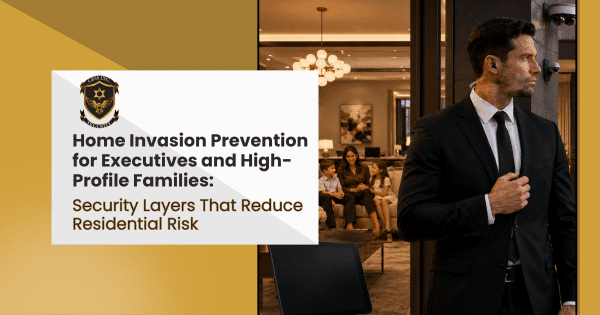
Home protection requires a similar mindset, but a different execution. Residential executive security is not only about reacting to break-ins. It is about reducing opportunity. That often includes perimeter visibility, gate and entry discipline, lighting, camera placement, visitor screening, delivery procedures, secure garage-to-interior transitions, family communication protocols, and planning for domestic staff, contractors, and service vendors. For some households, it may also include low-profile patrol coverage or a dedicated residential specialist.
The most important point is this: the residence should be treated as part of the executive security environment, not as a separate world. Threats do not respect property lines. A leader who is protected at the office but highly predictable at home is not fully protected.
This is where written planning matters. A formal protection plan should cover office routines, residential patterns, after-hours movement, family considerations, emergency contacts, and incident response expectations. Resources like CISA’s security planning workbook are useful because they reinforce a principle seasoned professionals already understand: planning, documentation, and regular review matter just as much as physical presence.
When organizations skip this planning step, they usually spend more later, either through inefficient staffing, overbuilt coverage, or avoidable incidents. When they do it right, security becomes cleaner, more targeted, and easier to maintain.
Secure Transportation, Public Appearances, and the Invisible Layer of Executive Protection
Movement is where executive exposure often spikes. The office may be controlled. The home may be hardened. The weak point is often the transition between locations.
Secure transportation is more than providing a driver. It is route awareness, timing discipline, vehicle staging, departure and arrival control, parking strategy, contingency planning, and situational awareness before the principal even enters the car. On routine days, this may look quiet and simple. On higher-risk days, it may include alternate routes, advance checks, coordinated arrivals, or a visible deterrent presence.
Travel increases the complexity. Airports, hotels, conference venues, restaurants, and rides between meetings all create moments of uncertainty. Schedules compress. Public exposure rises. Third-party environments become less controllable. That is why travel security planning should begin before wheels are up, not when the executive lands. A disciplined team will review destination risk, meeting visibility, hotel layout, motor route logic, arrival timing, emergency medical options, and communication plans. For international or higher-risk destinations, it is smart to align that planning with official travel safety guidance.
Public appearances create a similar need for advance work. A venue walkthrough, entry and exit review, credential awareness, crowd flow analysis, and coordination with site staff can eliminate a remarkable amount of friction. The executive should know where to go, who is controlling access, how unexpected approaches will be handled, and what happens if a protest, disruption, or medical incident unfolds. Good event security for executives is usually subtle. It is built around foresight, not visible panic.
Then there is the part many people miss: the invisible layer. The strongest physical program can be weakened by poor privacy habits. Overshared schedules, recurring lunch spots, publicly visible family routines, loosely managed assistant calendars, social media posts with live location cues, and vendor lists that circulate too widely can all create unnecessary predictability. Executive security is physical, yes, but it also depends on information control.
Simple discipline goes a long way:
- Avoid publishing real-time location details
- Limit broad internal distribution of full executive calendars
- Review who has access to home addresses and family details
- Keep travel itineraries on a need-to-know basis
- Audit social media habits for the executive and close family members
- Coordinate discreetly with assistants, drivers, and household staff
This is often where a professional program proves its value. It does not just place personnel. It shapes routine. It helps leaders move through daily life with less exposure and more confidence.
For clients who need a more visible deterrent for select environments, armed security protection can be integrated thoughtfully, especially for high-visibility appearances, sensitive transport movements, or locations with elevated threat indicators. The key is proportionality. Not every executive needs the same footprint every day.
Coverage Layers, Reporting Standards, Costs, and How to Choose a California Provider
No serious executive security plan is one-dimensional. Coverage should be layered according to risk, environment, and business need. In one situation, an unarmed professional with excellent presence and communication skills may be the right fit. In another, armed coverage, mobile patrol support, residential checks, or a specialized advance detail may be justified. The point is not to choose the most aggressive option. It is to choose the most appropriate one.
That planning usually falls into a few broad categories:
- Unarmed coverage for low-profile executive presence, office support, residential observation, and day-to-day deterrence
- Armed coverage where risk level, environment, or client preference calls for a stronger security posture
- Mobile support for route checks, perimeter observation, and multi-site flexibility
- Event-focused details for meetings, appearances, and executive gatherings
- Residential layers for home access control, patrol patterns, and family protection protocols
Just as important as staffing is accountability. A professional program should produce real documentation. That means incident reports when something happens, daily logs when coverage is ongoing, clear chains of communication, and escalation procedures that tell the client exactly how information flows. Security should never feel vague. The client should know who is on post, what occurred, what was observed, and what changed.
This is one of the clearest differences between professional coverage and improvised coverage. Serious providers do not rely on memory and casual texting. They build records, communicate cleanly, and create a reviewable security picture over time. That matters for risk management, insurance conversations, executive confidence, and operational continuity.
Cost, of course, matters too. Executive protection pricing is typically driven by scope, not by a single flat idea of “bodyguard cost.” The biggest pricing variables usually include the number of personnel, armed versus unarmed coverage, hours per day, schedule complexity, travel days, advance work, after-hours requirements, residential assignments, event support, and whether the detail is ongoing or temporary. The cheapest setup is often the least efficient if it is not properly matched to the threat picture. A smarter approach is to define the real need, then staff the plan accordingly.
In California, choosing the right provider starts with legitimacy. The company should be properly licensed, operationally organized, insured, and capable of communicating clearly with executive stakeholders. Ask practical questions:
- Are you a California-licensed private patrol operator?
- What is your reporting process?
- How do you handle incident escalation?
- Can you support office, residential, and transportation coverage as one program?
- How do you balance visibility and discretion?
- What does your handoff and communication structure look like?
- How do you adapt coverage when risk conditions change?
The right provider should make security feel easier, not more chaotic. They should speak in plans, layers, contingencies, and accountability. They should understand that protecting a leader also means protecting the pace of the business.
If your team is evaluating what that could look like in practice, the best next step is a focused conversation about where the real exposures live today. You can contact CB Security Solutions to discuss office coverage, residential protection, secure transportation, or a more tailored executive protection strategy built around how your leadership team actually moves.
Takeaway
A practical executive security plan is built around three things: where the leader works, where the leader lives, and how the leader moves. When those three environments are connected by real planning, disciplined reporting, and the right level of coverage, security becomes less disruptive, more effective, and far more valuable to the people it protects.