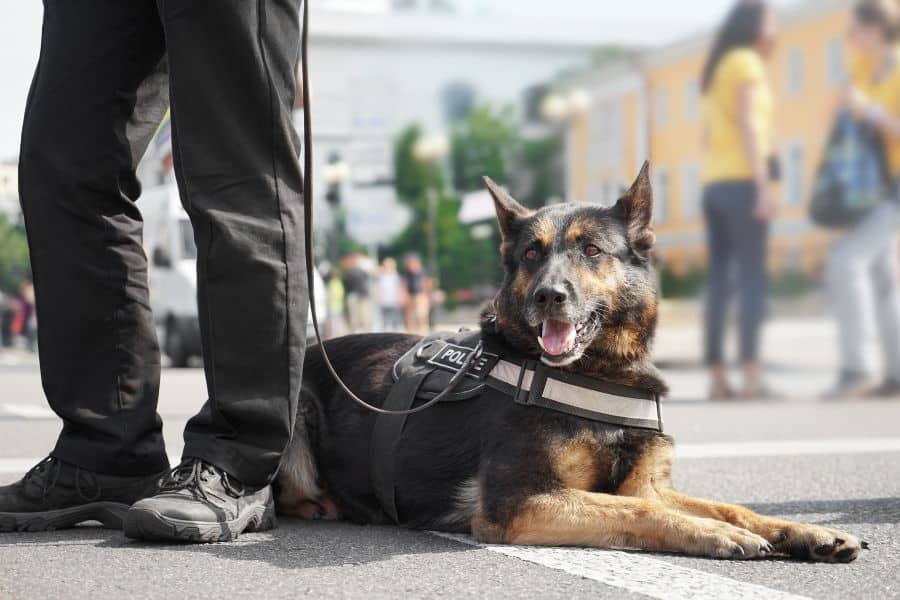

K9 security has a way of changing the atmosphere of a site the moment a team steps onto it. A well-trained dog and handler do more than add presence.
They sharpen detection, widen coverage, and often stop trouble before it gathers momentum. That is why many organizations that pair visible deterrence with rapid response also consider armed security protection as part of a broader security plan.
The scale of modern canine deployment helps explain why.
Federal transportation security operations in the United States still rely on more than a thousand canine teams nationwide, which says something important: even in a world full of cameras, sensors, and software, trained dogs still solve problems technology alone cannot.
What “K9 Security” Means, and the Types of Teams That Matter
“K9 security” does not simply mean bringing a dog onto a property and calling it protection. In professional settings, it means a trained canine working with a trained handler for a defined security purpose. The handler is the operator. The dog is a specialized tool. The value comes from the team, not the animal alone.
Most clients are really choosing between a few distinct K9 functions:
- Explosive detection K9s for venue screening, vehicle sweeps, parcel checks, and pre-event clearance
- Narcotics detection K9s for contraband concerns in specific environments
- Patrol or deterrence K9s for perimeter presence, intruder response, and psychological deterrence
- Dual-purpose teams in select environments where detection and visible deterrence both matter
That distinction matters because the wrong dog for the wrong assignment creates friction, not security. A discreet detection dog may be ideal for a studio lot, a corporate campus, or a VIP arrival where you want calm but capable screening. A more visibly assertive patrol dog may be more appropriate for a high-risk perimeter, logistics yard, or restricted facility where deterrence is part of the job itself.
This is also where good security planning gets more mature. Instead of asking, “Do we want a K9?” the better question is, “What problem are we trying to solve?” If the problem is suspicious parcels, entry screening, or pre-opening sweeps, you are likely thinking about detection. If the problem is perimeter breaches, trespass activity, or visible deterrence after hours, you may be thinking about patrol support.
For clients, the practical takeaway is simple: K9 units work best when the objective is narrow, the post orders are clear, and the handler has room to do the job correctly. If your site needs a team that can project command presence while fitting into a disciplined protective posture, it often makes sense to evaluate K9 support alongside armed security protection, not as a novelty, but as part of a layered response model.
What K9 Units Actually Do on a Detail
A lot of people picture K9 teams as dramatic, high-intensity assets used only when something has already gone wrong. In practice, the best K9 work is often quiet, methodical, and preventive.
On a typical assignment, a K9 team may handle:
- Pre-shift screening sweeps of entrances, loading areas, green rooms, trailers, or back-of-house space
- Vehicle and parcel sweeps before access is granted
- Perimeter checks for blind spots, fences, service roads, and low-visibility corners
- Presence patrols in parking structures, logistics zones, and restricted areas
- Targeted response support when a suspicious item, person, or vehicle needs an additional layer of assessment
- Deterrence by visibility, which is often one of the most valuable effects a K9 team creates
This is where K9 security becomes more strategic than people expect. Dogs do not replace site supervisors, access control staff, cameras, or patrol officers. They strengthen those systems by adding mobility, scent-based detection, and a form of visible authority that often changes behavior before a confrontation starts.
A strong team also knows when not to overplay its role. A professional handler does not turn every walk-through into a spectacle. In polished environments, especially in hospitality-adjacent or executive-facing settings, the dog should feel controlled, steady, and purposeful. The presence should register immediately, but it should not create unnecessary alarm.
That balance matters in places like studio and production environments, where talent, crew, executives, and vendors are moving constantly. It also matters at high-value logistics sites, where the issue is less public reassurance and more targeted screening, perimeter integrity, and controlled access. In those environments, a K9 team is most useful when it supports the operation without becoming the operation.
Clients considering K9 deployment should map the detail in advance:
- What must be swept, and how often?
- Where are the choke points?
- Which zones are public-facing, and which are restricted?
- Is the team there to detect, deter, or both?
- What will the handler report up the chain of command?
Those questions turn a K9 team from an expensive add-on into a useful asset. If you want help assessing whether that asset belongs on your site, the cleanest next step is to contact CB Security Solutions and evaluate the assignment against actual risk, not just instinct.
Best Use Cases for K9 Security, and When It Is Worth the Budget
K9 security is not for every property, every schedule, or every threat profile. It becomes worth the budget when the site has a real detection need, a meaningful deterrence need, or both.
Some of the strongest use cases include:
- Warehouses and logistics sites with high-value goods, large footprints, trailer movement, and limited overnight staffing
- Studios and productions where controlled access, vehicle sweeps, and discreet protection matter
- Corporate campuses with multiple buildings, open pedestrian flow, parking structures, or executive traffic
- High-value inventory environments where loss prevention and perimeter integrity are both priorities
- Select VIP activations and high-profile events where screening and visible security need to coexist
A good way to think about value is this: K9 units are strongest where traditional patrol alone leaves gaps. A dog can move faster than static screening, cover scent-based tasks technology cannot, and create a deterrent effect that is hard to replicate with signage or cameras.
That said, there are times when K9 is not the smartest spend.
K9 may not be the right fit when:
- the site is low risk and mostly needs consistent guard presence
- the client wants a dog mainly for appearance, without a defined operational purpose
- the environment is too cramped, chaotic, or poorly planned for safe deployment
- access control, lighting, cameras, or basic staffing are still weak and need fixing first
In other words, K9 units are force multipliers, not substitutes for sound fundamentals. If a facility has broken perimeter discipline, weak visitor management, and no reporting structure, adding a dog will not solve the underlying problem. But if the basics are already in place, K9 can make a good security plan sharper, faster, and more persuasive.
That is often where the comparison to cameras becomes clearer. Cameras document. K9 teams detect, deter, and influence behavior in real time. The smartest clients do not choose one or the other. They decide how each tool should perform in the same system.
Planning Requirements, Safety Protocols, and Public-Facing Rules
The most successful K9 deployments are planned with discipline before the first shift begins. That means thinking through the dog’s working conditions, the handler’s route, the public interface, and the site rules that will keep the deployment controlled.
At minimum, every site should account for:
- handling area and movement lanes
- relief schedule
- fresh water and, when needed, shade or cooling support
- crowd flow and standoff space
- restricted contact rules
- clear escalation and reporting procedures
This is especially important in public-facing environments. A K9 team should never feel improvised. Staff should know the dog is handler-controlled. Visitors should not be encouraged to touch, distract, or interact with the animal unless the handler explicitly allows it. Signage and verbal direction should make the rules simple and calm.
There is also a deeper point here: a professional K9 presence can support de-escalation only when the team is disciplined. The dog should not become a source of confusion. It should help create order. That means measured route planning, controlled approaches, and a handler who understands not only canine behavior, but public behavior.
For crowded or high-visibility details, smart protocol usually includes:
- a defined buffer around the dog
- no petting or photo requests while the team is working
- designated screening zones instead of random stops
- clear handler-only commands and client-approved response steps
- documented incident reporting after notable interactions
Environmental planning matters too. Outdoor details, asphalt lots, event queues, and sun-exposed perimeters require practical welfare planning, not assumptions. Water, breaks, surface awareness, and heat considerations are part of professional deployment. They are not optional extras.
Clients often overlook this because they are focused on capability. But capability depends on conditions. A dog working in the wrong environment, for too long, without the right rotation, becomes less effective. Good K9 operations respect that reality from the start.
Integration With Your Overall Security Stack, and the Real Cost Drivers
The strongest K9 deployments are integrated, not isolated. A canine team should fit into the rest of the security stack with clarity.
That usually means pairing K9 with:
- patrol officers for perimeter depth and response support
- access control for screened entry and credential discipline
- CCTV for verification, review, and coverage overlap
- supervisory reporting for clean communication and chain of command
When those pieces work together, the dog is no longer a standalone feature. It becomes part of a layered system that can search, observe, document, and respond with more confidence.
Cost follows the same logic. K9 pricing is usually shaped by a handful of drivers:
- team type, meaning detection, patrol, or dual-purpose capability
- hours and shift design
- travel and transport
- coverage footprint
- site complexity and risk profile
- whether the deployment is ongoing, event-based, or short notice
The right question is not whether K9 security costs more than a standard post. It usually does. The right question is whether the assignment justifies specialized capability. On the right site, the answer is yes. On the wrong site, the more responsible answer is no.
At CB Security Solutions, K9 deployment is approached the same way all serious protective work should be approached: disciplined handler protocols, discreet but credible presence, fast response, clean reporting, and respect for the chain of command. Where appropriate, a K9 unit can add meaningful security value. Where it is not appropriate, honest guidance matters just as much.
If you are weighing options for a warehouse, production environment, campus, or executive-facing detail, contact CB Security Solutions for a practical assessment. The goal is not to oversell a dog. The goal is to build the right security posture for the job in front of you.
Takeaway
K9 security is worth it when it solves a specific problem: better detection, stronger deterrence, smarter perimeter coverage, or a more capable layered security posture. When the handler is disciplined, the mission is clear, and the deployment is integrated with the rest of the security plan, a K9 team can do something rare in modern security. It can make a site feel calmer, stronger, and harder to test.
For reference, while drafting or publishing, the article also naturally aligns with outside resources such as the TSA Canine Training Center, CBP canine disciplines, and AVMA warm-weather pet safety guidance.