
A gated community should feel calm, orderly, and well-run, not tense, theatrical, or over-policed. The best security programs quietly build confidence.
They make it easier for residents to come home, for visitors to be properly screened, and for problems to be noticed early, before they turn into claims, complaints, or emergencies.
That matters even more when residential property crime remains a real concern. According to the Bureau of Justice Statistics’ 2024 national victimization data, U.S. households experienced 13.1 million property victimizations, including burglary or trespassing, motor vehicle theft, and other household theft. For HOAs and property managers, that is a reminder that security should be designed as an operating system, not treated like a decorative amenity.
If your board is evaluating what stronger coverage could look like, CB Security Solutions can help you assess the right mix of patrol, post coverage, and armed security protection for your property’s actual risk profile.
What Makes Gated Community Security Different
Gated community security is different because the mission is different. A warehouse, construction site, or retail center is mostly protecting inventory, access points, and business operations. A residential community is protecting something more personal: the daily rhythm of where people live. That changes the tone, the expectations, and the margin for error.
Residents want visible security, but they also want courtesy. They want officers to be alert, but not abrasive. They want strangers screened, but they do not want guests turned away because a process is confusing or inconsistent. In other words, residential security has to be firm and polished at the same time.
That is why a good HOA security plan usually begins with clarity, not gadgets.
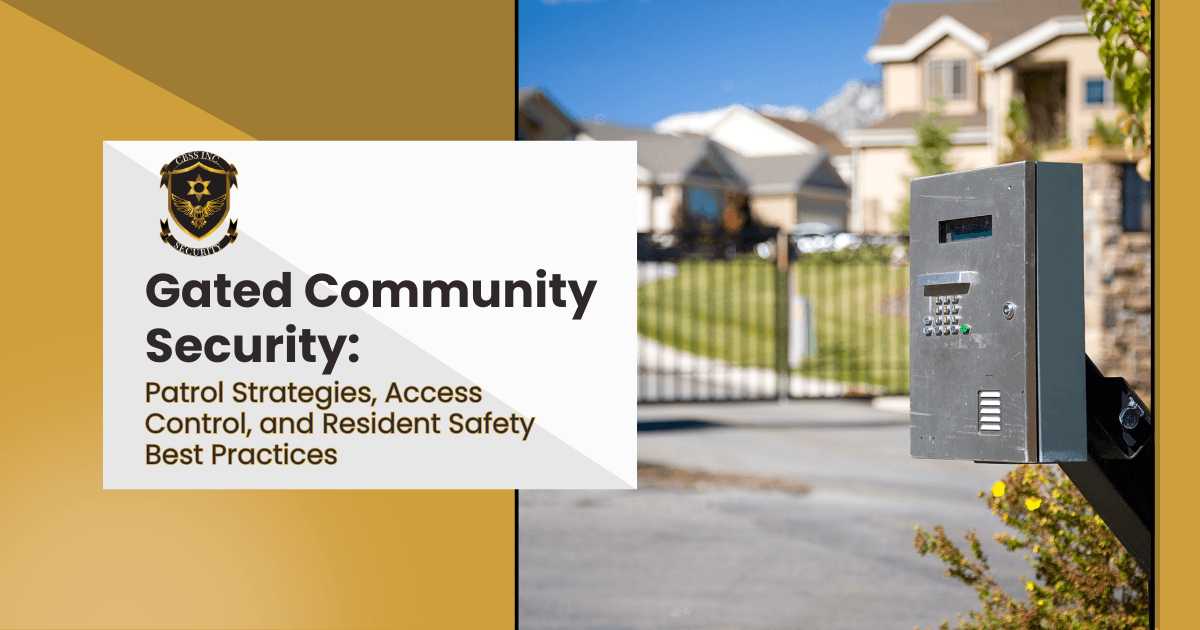
Access Control That Works in Real Life
Access control succeeds when it matches how the community actually functions on a normal Tuesday, a holiday weekend, and a busy evening with deliveries, vendors, dog walkers, rideshares, guests, and residents all moving through at once. The most effective gatehouse procedures are practical enough to follow every day.
That usually means:
- keeping current resident lists and approved-entry procedures up to date
- establishing a consistent visitor verification process
- separating resident, guest, and vendor workflows so guards are not improvising under pressure
- requiring vendor screening for recurring contractors, movers, landscapers, and service teams
- documenting exceptions instead of relying on memory
- considering LPR options where the property wants searchable vehicle-entry records and local rules support it
The goal is not to create friction for its own sake. The goal is to remove ambiguity. When an officer knows exactly what to do with an unlisted visitor, an early-morning vendor, or a delivery driver who wants to tailgate through the gate, the property is less exposed.
This is also where many communities make the same mistake: they confuse a gate with a security plan. A gate is only a tool. If residents prop pedestrian entries open, if guest lists are never updated, if vendors come and go with no verification, or if officers are expected to “use their judgment” without real post orders, then the property has an access point, not access control.
A strong residential program also accounts for community culture. A family-heavy neighborhood may need smoother school-hour traffic handling. A luxury community may care more about discretion, privacy, and professional presentation. A condo or townhouse development may need closer coordination around package zones, garage access, and shared amenities. Security should reflect the site, not force the site into a generic template.
Tasteful security should feel organized, calm, and consistent. When that is done well, residents stop thinking of security as a nuisance and start seeing it as part of the property’s standard of care. And if your board wants to pressure-test its current access procedures, the simplest next move is to contact CB Security Solutions for a site-specific review rather than guessing from incident to incident.
Patrol Strategy Options
Patrol strategy is where many communities either gain real control or lose it. A patrol program that looks active but follows the same route at the same time every night can become predictable fast. A patrol program that is too random, however, can leave blind spots around gates, garages, mail areas, clubhouses, and pool decks. The right answer is structure with variation.
Vehicle Patrol Routes, Foot Patrol Hotspots, and Randomized Coverage
Vehicle patrol works well for larger communities, long interior roads, perimeter checks, and after-hours visibility. Foot patrol works better in tighter spaces where officers need to read body language, check doors and amenities closely, and interact with residents. The strongest programs usually combine both.
A practical patrol design often includes:
- fixed checks at known risk points such as gates, mailrooms, package lockers, pools, gyms, and parking areas
- randomized passes along perimeter edges and lower-visibility streets
- extra presence during predictable risk windows, such as evening package delivery periods, late-night amenity use, and early-morning vendor arrivals
- patrol logs that record not only presence, but findings and corrective action
The important question is not “Did security make rounds?” The important question is “Were the rounds shaped around where problems actually happen?”
For example, if vehicle break-ins cluster near poorly lit guest parking, that area should receive more than casual drive-bys. If noise complaints spike near the clubhouse on weekends, patrol presence should increase before the issue peaks, not after several residents have already called. If the property has recurring trespass concerns near a pedestrian gate, security should review whether the problem is staffing, lighting, hardware, landscaping, or all four.
“Soft Skills” That Matter in Residential Posts
Residential posts live or die on soft skills. A technically correct officer who communicates badly can create almost as many management headaches as the incident itself. In gated communities, officers represent order. Their presence should lower the temperature.
That means officers need to know how to:
- speak clearly and respectfully under stress
- set limits without sounding combative
- de-escalate noise complaints, parking disputes, and guest-entry conflicts
- distinguish between a resident inconvenience and a real safety issue
- document interactions neutrally, without sarcasm or editorial language
This is especially important during disputes between neighbors. Domestic disturbances, repeated noise complaints, parking confrontations, and amenity-rule conflicts can become emotionally charged very quickly. In those moments, residents do not just need an officer who is visible. They need one who is composed.
That is one reason many communities benefit from security providers that treat communication as part of the service, not as an afterthought. If the post’s threat picture is higher, or if the property includes sensitive residents, contentious visitor patterns, or repeated nighttime disturbances, it may also make sense to evaluate whether armed security protection belongs in part of the overall coverage model. That should never be a branding decision. It should be a risk-based one.
Common Incident Types and Response Playbooks
Most gated community incidents are not dramatic. They are repetitive. And repetitive incidents are exactly where a property either builds confidence or creates frustration. Good security teams do not treat common issues as one-off annoyances. They build playbooks.
The Incidents Most Communities See Again and Again
A typical HOA or residential community security program should be prepared for:
- trespassing and tailgating through gates
- package theft or suspicious loitering around mail areas
- vehicle break-ins in guest parking or dark perimeter zones
- domestic disturbances and welfare-check concerns
- noise complaints tied to amenities, parties, or short-term guest activity
- suspicious persons near pool areas, clubhouses, or pedestrian access points
Each of these needs a different response path. Trespass concerns often begin with access-control failure. Package theft often involves timing, visibility, and resident communication. Vehicle break-ins usually expose weaknesses in lighting, patrol timing, or camera placement. Domestic calls require calm separation, observation, documentation, and rapid law-enforcement escalation when safety is at risk.
For package-related losses especially, communities should pair patrol with resident education. The U.S. Postal Inspection Service’s package-theft guidance emphasizes prompt pickup, alternate delivery arrangements, hold-for-pickup options, and signature confirmation. In a gated community, that translates into practical steps: better mail-area surveillance, clear resident reminders, delivery-zone visibility, and quick reporting when suspicious activity appears.
Resident Communication Systems
A property is safer when residents know exactly how to report issues and what happens next. Too many communities rely on informal text chains, front-desk complaints, and vague assumptions about when to call security versus management versus 911.
A better model gives residents a clear ladder:
- urgent threat or active violence: call 911 first
- live security concern on property: call on-site security or the dedicated community line
- non-emergency recurring issue: submit through management and security reporting channels
- follow-up after an incident: receive documented closure or status communication
This matters because response quality is not only about how officers act in the moment. It is also about what happens after. Did the resident who reported a trespass ever hear back? Did management learn that the same garage door failed three nights in a row? Did the board receive enough detail to authorize lighting repairs, camera repositioning, or staffing changes?
Security loses value when information dies at the curb.
Cameras, Lighting, Perimeter Hardening, Staffing, and Reporting
Technology works best when it supports good operations. Cameras should cover movement, not just walls. Lighting should make it easier to see and harder to hide. Landscaping should not create easy concealment near gates, mail areas, or pedestrian pathways. In older communities especially, small physical fixes can solve problems that extra patrol hours alone will not.
That is why good residential security often includes:
- entry-point surveillance that clearly captures vehicles and pedestrian approaches
- lighting audits for dark walkways, guest parking, garage approaches, and side gates
- blind-spot fixes around foliage, walls, dumpster enclosures, and amenity corridors
- perimeter checks for fence damage, failed latches, and recurring access breaches
The broader principle is simple: design should support observation and control. The Justice Department’s CPTED guidance has long emphasized lighting, access control, and natural surveillance as core crime-prevention tools. For residential properties, that means making it easier for staff, residents, and cameras to notice what does not belong.
Staffing should be built around real need, not habit. Some properties need a 24/7 gatehouse. Others do better with hybrid coverage: peak-hour gate staffing, evening patrol, and stronger overnight checks. Some communities need surge coverage during board meetings, holidays, move-ins, or contractor-heavy renovation periods. There is no prize for overstaffing a low-risk post, and there is no savings in understaffing a troubled one.
Finally, reporting is what turns security from a labor line item into a management function. Good reporting includes daily logs, clean incident reports, and weekly summaries that tell managers and boards what happened, what patterns are forming, and what action is recommended next. The point is not paperwork for its own sake. The point is to give leadership visibility.
That is where CB Security Solutions can be especially valuable for HOA clients. CBSS emphasizes fast response, clear documentation, and ongoing communication, with coverage built around the site’s actual risk profile. For communities that need a provider who can pair professional on-site presence with practical follow-through, the best next step is to contact CB Security Solutions and map out the right coverage model for your gates, amenities, parking areas, and resident concerns.
Short takeaway
The best gated community security does not rely on a gate alone, a camera alone, or a guard standing in the wrong place at the wrong time. It comes from a layered system: access control that people actually follow, patrols shaped around real hotspots, officers with strong judgment and communication skills, and reporting that helps managers solve problems before they repeat. When those pieces work together, residents feel the difference right away.