
When a fire alarm panel goes dark or a sprinkler system is taken out of service, the risk picture changes immediately. A property that felt manageable an hour ago can suddenly need manual life-safety coverage, clearer communication, and tighter coordination with the local fire authority. If your site also needs a stronger overall protective posture when systems are impaired, CB Security Solutions can help you evaluate whether armed security protection should be included in the broader response plan.
According to the NFPA’s fire loss research, U.S. fire departments responded to roughly 1.39 million fires in 2024, which works out to about one fire every 23 seconds. That is exactly why fire watch exists. It is about closing the gap when normal systems, conditions, or procedures cannot be trusted to do the whole job on their own.
What Fire Watch Security Is
Fire watch security is a temporary, active safety measure used when a building, event, or work area needs human eyes on it for fire prevention and early response. It is not passive coverage. It is not a guard sitting near a desk waiting for something to happen. A real fire watch guard is assigned to patrol, observe, document, communicate, and respond according to the site’s fire safety instructions and the direction of the authority having jurisdiction (AHJ).
That distinction matters more than most people realize.
A standard security presence may focus on access control, theft deterrence, trespassing, or customer-facing issues. Fire watch, by contrast, is centered on identifying fire hazards, spotting early signs of smoke or heat, alerting occupants, and ensuring the fire department can be notified quickly if conditions change. The role is narrower, but in the moment, it is more urgent.
In practical terms, fire watch services are usually brought in when a required fire protection system is impaired, when hot work creates elevated ignition risk, or when a fire official decides public safety requires dedicated patrol coverage. The point is not just to “have someone there.” The point is to maintain continuous awareness in the exact areas where a missed spark, blocked exit, or delayed notification could make a bad situation much worse.
That is also why a proper fire watch assignment usually comes with structure:
- clearly defined patrol areas
- a required patrol frequency
- a communication method for emergencies
- written logs documenting rounds and findings
- instructions on how to notify occupants and emergency responders
If you are trying to decide whether your site needs ordinary guard coverage or a code-sensitive fire watch plan, the safest move is to treat them as different services with different purposes. And if the impairment is happening at a site that also faces elevated threat, high-value assets, or after-hours exposure, a broader conversation about armed security protection may be appropriate alongside the fire watch itself.
When Fire Watch Is Required in California
In California, fire watch commonly comes into play when a required fire protection system is out of service, when hazardous conditions are present, or when certain activities such as construction, demolition, trade shows, or hot work create extra fire risk. The cleanest starting point for site teams is this: do not assume fire watch is optional just because the outage or hazard feels temporary.
If a required system is impaired, the local fire code official or fire marshal may require an approved fire watch until the system is restored or the condition is otherwise cleared. In many cases, the owner, manager, agent, lessee, or person in control of the property is the one responsible for making notifications and arranging coverage. California fire authorities and the Office of the State Fire Marshal make that chain of responsibility very clear.
Common real-world fire watch scenarios include:
- a fire alarm system malfunction or shutdown
- a sprinkler system that is out of service
- planned system testing that leaves parts of the building temporarily unprotected
- emergency impairments after leaks, electrical issues, or damage
- hot work such as welding, cutting, grinding, or torch operations
- construction or demolition conditions where the fire code official requires on-site fire watch
- assembly or exhibition settings where public safety conditions justify dedicated personnel
This is where many site managers make a costly mistake. They assume the question is simply, “Do I need a guard?” The better question is, “Who has ordered or can order the fire watch, who must be notified, and what exact conditions must the coverage meet?” That answer often comes from the AHJ, not from guesswork, habit, or what another building did last year.
The local fire authority may set the patrol interval, the number of personnel, the areas to be watched, the reporting expectations, and the conditions for ending the fire watch. In other words, compliance is not just about staffing a body. It is about following the coverage terms the fire authority expects to see.
If you are dealing with an active impairment, treat the first hour seriously. Confirm the condition, notify the required parties, clarify whether occupants remain exposed, and get coverage in motion quickly. If your property team wants help translating that operational pressure into a clear security plan, contact CB Security Solutions and walk through the site conditions before the outage becomes a longer and more expensive problem.
What Fire Watch Guards Actually Do on Shift
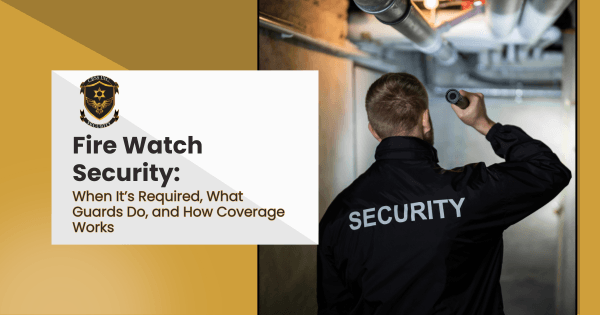
A good fire watch shift is disciplined, repetitive, and detail-heavy in the best way. The guard is not there for improvisation. The guard is there to patrol methodically, keep attention on the real hazards, and record what was actually checked.
On shift, fire watch guards typically do the following:
- patrol designated interior and, when directed, exterior areas
- watch for smoke, fire, heat sources, unsafe conditions, blocked egress, or other hazards
- maintain communication capability to notify emergency responders quickly
- help alert occupants and support evacuation procedures when required
- document patrol rounds, times, findings, and notable conditions in a fire watch log
- stay focused on fire watch duties only, without unrelated post tasks distracting them
The phrase “duties only” is important. Fire watch is not something that should be casually layered onto a receptionist, maintenance employee, or general-purpose guard who is already doing three other things. When people say a fire watch guard “just walks the property,” they miss the point. The patrol itself is the work.
Staffing levels and patrol frequency
Staffing depends on the site, the occupancy, and the direction of the fire authority. On one property, one guard may be enough for the designated area. On another, the footprint, blind spots, occupied floors, or hot work configuration may require multiple guards, overlapping zones, or tighter intervals.
As a practical rule, occupied sites with sleeping occupants, assembly uses, institutional settings, or complicated layouts usually demand more attention than a simple low-density site. That is why patrol frequency is often set by the AHJ rather than assumed by the client.
Fire watch documentation
Documentation is one of the clearest differences between real fire watch coverage and generic extra patrol. A valid fire watch log should tell the story of the shift in plain language. It should show when rounds happened, who completed them, what areas were checked, and what was found. If an exit was blocked, if a hazard was corrected, if a communication was made to the fire department or monitoring company, the log should reflect it.
Some fire authorities want logs maintained on-site for inspection. Others may require logs to be emailed or delivered daily. That means your provider should not treat reporting as an afterthought.
What the site must provide for fire watch to work
Even the best guard cannot run an effective fire watch without access and instructions. In practice, the site should be ready to provide:
- complete access to the affected areas
- keys, codes, badges, or escorts where necessary
- the exact property address and emergency contact chain
- the evacuation procedure and occupant notification method
- clarity on which systems are impaired and which zones are affected
- any special directions from the fire marshal or fire code official
The cleaner that handoff is, the better the coverage performs. If your site is scrambling, that is exactly when a provider with organized reporting, responsive communication, and calm field discipline matters most.
Fire Watch vs Alarm Monitoring vs “Extra Patrol,” and How to Hire the Right Provider
This is where buyers often get tripped up.
Alarm monitoring is valuable, but it is not the same as a fire watch. Monitoring depends on systems, signals, and remote response pathways. Fire watch depends on a trained person physically inspecting the space. If the system itself is impaired, monitoring may not solve the core problem at all.
“Extra patrol” is also not the same thing. A general patrol assignment may help with visibility, trespassing, or after-hours presence, but it is not automatically structured to meet fire watch requirements. If there is no dedicated patrol route, no fire-specific instructions, no defined reporting, and no focused life-safety mission, it is not a substitute.
That is why hiring the right provider matters. Before you hire anyone, ask questions that get past the sales language:
- Are you licensed and operating in California?
- How fast can you staff an emergency impairment?
- Who sets the patrol frequency and how do you document it?
- What does your fire watch log look like?
- How are issues escalated in real time?
- Can your team coordinate cleanly with property management and the local fire authority?
- What supervision and reporting cadence should I expect?
Pricing usually follows the operational reality of the assignment. Costs tend to rise with longer durations, 24/7 coverage, more guards, larger patrol footprints, more complicated occupancy conditions, urgent dispatch timelines, and heavier reporting requirements. The cheapest quote is often the least useful if it does not match the actual conditions the site is dealing with.
For clients comparing options, CB Security Solutions brings the kind of fundamentals that matter in time-sensitive coverage: California licensing, fast response, clear communication, and documentation that keeps stakeholders informed. The company emphasizes professional on-site presence, reliable staffing, and reporting that helps managers understand what happened and what was checked. If your impairment event also sits inside a larger risk picture, CBSS can help you think beyond the minimum and assess whether armed security protection or a more layered security posture makes sense for the property as a whole.
When the situation is active, the best next step is not to speculate. It is to get specific. Contact CB Security Solutions with the site type, occupancy status, impaired systems, expected duration, and any fire department direction already received.
Takeaway
Fire watch security is not filler coverage. It is focused, temporary life-safety protection used when systems are down, hazards are active, or the fire authority requires dedicated patrols. The right provider brings quick staffing, disciplined patrols, usable logs, and clear communication, which is exactly what sites need when there is no room for confusion.